9. Refinishing dials

29 09 2013

A few days ago I received what looks like a chronometer but isn’t. It has a face that says it came from the Hamilton Watch Company, Pa, it has a seconds dial at 6 o’clock and a “wound up/down” dial at twelve. However, the movement was made by Fema, a London firm and the escapement is a good quality Swiss lever one. In WWII many navigational watches were made by Hamilton and they performed as well as many chronometers, while in Germany, some chronometers were fitted with lever escapements for use by the Luftwaffe, so it remains to be seen how the new “chronometer” will perform. In addition to much dust and the occasional insect remains found in the movement, the dial was in poor condition with many scratches showing the brass through a heavy coat of silver, so I elected to re-silver the dial.

The first step was to strip off the old silver and the easiest way to do this, which also gives a nice clean brass surface for the subsequent coating, is to abrade it. This is best done wet, as it stops the 240 grit emery paper from clogging. I immerse a flat sheet of Paxolin in some water (but 6 mm plate glass would do just as well) add a few drops of dish-wash liquid and place a sheet of emery paper on top. It is then just a matter of carefully rubbing the dial, face downwards of course, over the paper with light pressure. Traditionally, the face was given a horizontal grain, but in twentieth century chronometers the practice seems to have fallen into disuse. I keep to up and down so that there are no circular scratches or swirls that then have to be laboriously removed later. Once all the old silvering has been removed , a few strokes on 800 and then 1200 grit paper give a very fine surface to which the silver will hold very nicely.

The surface is also very clean, so the dial should now be held only by the edges while it is heated up. I use an old electric iron for this and invert it in a vice. Sealing wax, the traditional material for filling in the chapter rings etc. , is getting harder to find, but I have a precious stock of deep blue wax to which I have added black pigment. Figure 1 shows the dial nearly obliterated by the black sealing wax. Nearly as good is Araldite loaded with some black pigment. I have used some black tile-grouting stain left over from a bathroom renovation that took place so long ago that I can no longer visualise the bathroom that needed black grouting, but the wax seems to give a better finish and anyway, it is more fun. There is no reason why gloss acrylic paint should not be used. The Araldite and paint methods do not of course need the dial to be heated…
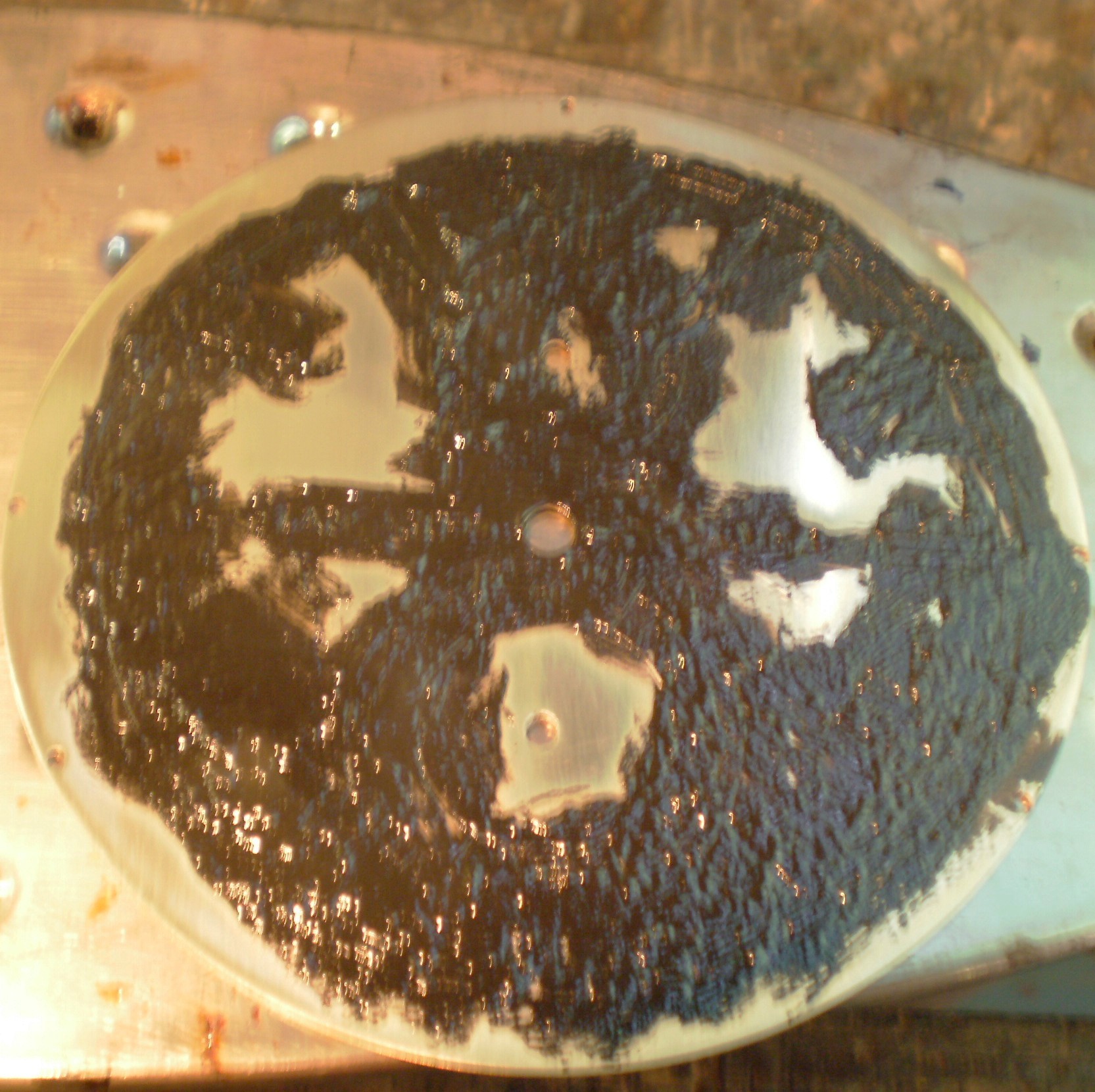
Figure 1: Filling with sealing wax.

Figure 1: Filling with sealing wax.

As soon as the dial is hot enough to melt the wax, it is spread rapidly, taking care that the dial does not get hot enough to make the wax bubble. The iron can be adjusted to the right temperature. Then using a soft scraper, like a wooden iced lolly stick, scrape off most of the wax to leave the chapter rings, letter and numerals outlined as shown in Figure 2.

Figure 2: Surplus wax scraped off.

Figure 2: Surplus wax scraped off.

The remaining wax is then abraded off as before, to leave a clean surface for the silver. The ingredients for silvering are available from horological suppliers. I use one called Horosilv, which I believe is silver chloride, which is then fixed with sodium potassium tartrate. A damp cotton ball is dipped into the silvering powder and rubbed on the dial with a circular motion until the yellow of the brass turns to the matt white of silver. If the brass is really clean, the process takes no more than a few minutes. Figure 3 shows the process half-completed on an orphaned Mercer dial.
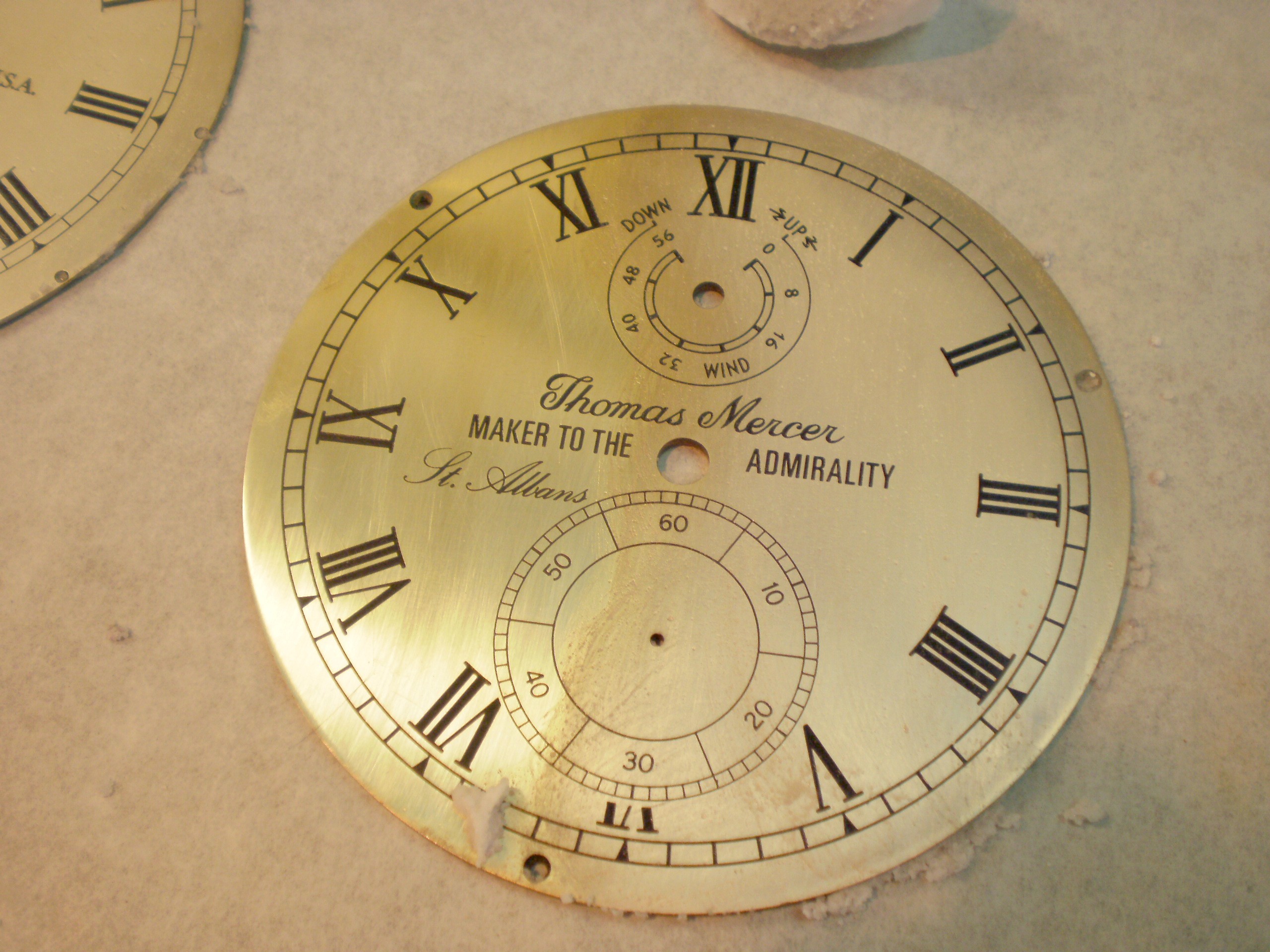
Figure 3: Silvering half completed.

Figure 3: Silvering half completed.

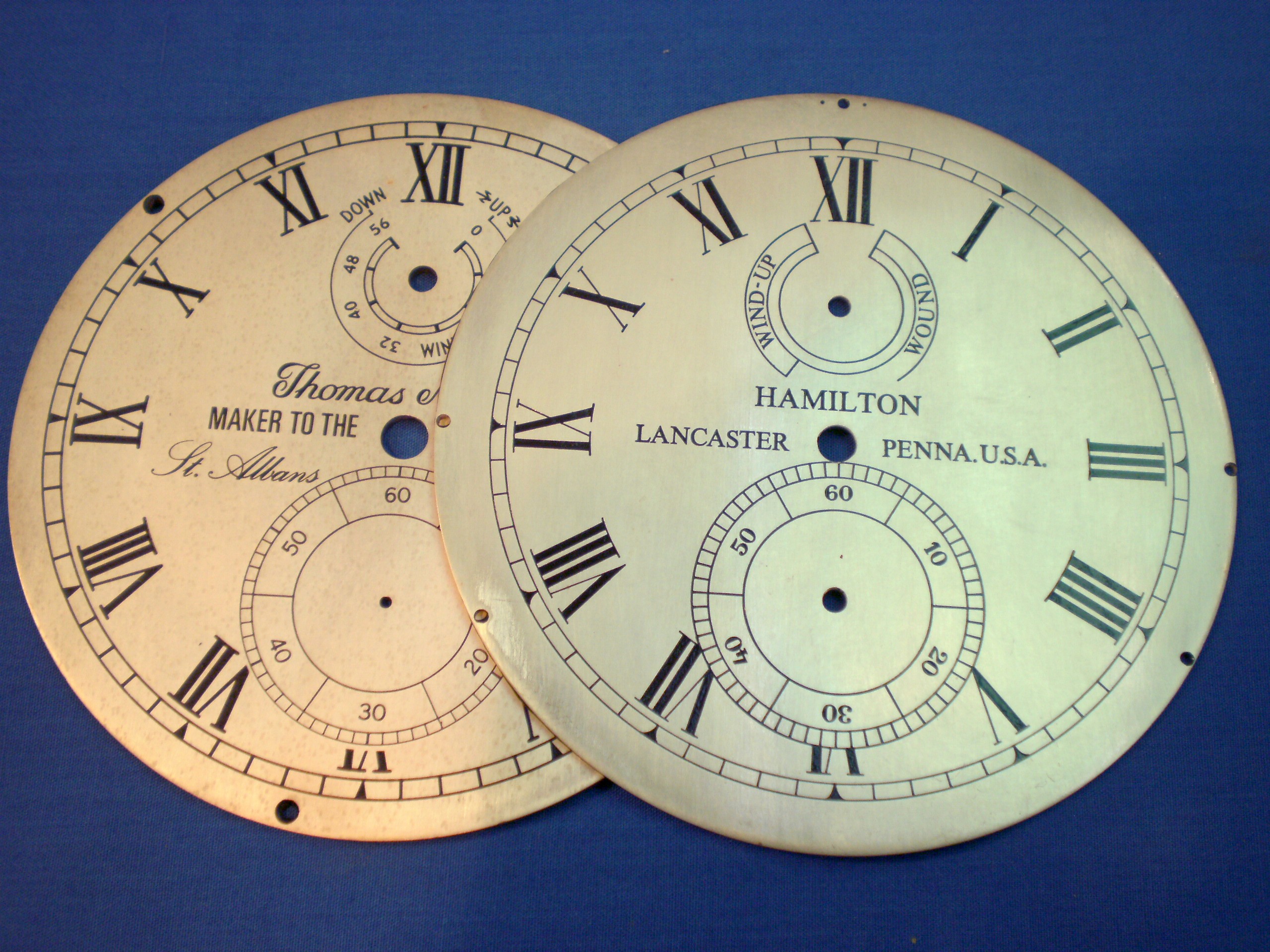
Once the silver shows a uniform coating, with no hint of yellow, the silvering powder is washed off and a thin paste of the fixing powder rubbed on, again using a cotton ball with a circular motion. This is then washed off and the dial patted dry with a soft cloth. Figure 4 shows the end result. the difference in colour of the two dials is due simply to the lighting. To get a really good finish, the dial may be heated until the sealing wax just starts to melt, when it becomes shiny. It must not be overheated as then bubbles may form and the job will have to be repeated.
Dials 006

Figure 4: Silvering and fixing completed.

I live 200 km from the nearest industrial area, so tarnishing of the silver is not a problem for me. Traditionally, the silver was lacquered, but getting a good finish is a craft skill that I have not yet acquired. Again, the dial needs to be warmed gently and the lacquer sprayed or brushed on evenly. An alternative that works with Araldite and paint fillings is to apply silicone wax polish, but the solvents in such polishes may dissolve sealing wax so that the silver gets faintly stained with black when the wax is rubbed off. This has certainly been my experience. It is no disaster if it happens, as to repeat the process is so quick and simple.


8. Making a chronometer key

30 07 2013

A marine chronometer must never be wound clockwise except for those few that have a winding square on the front or side of the instrument. Winding in the wrong direction risks damage to the maintaining power mechanism and, if reverse power should reach the train, the locking stone and detent may be damaged. For this reason, all makers provided a key that would wind only in an anti-clockwise direction and which would slip if clockwise winding was attempted, rather than rely on the user’s memory. They are often referred to as “tipsy keys.” Most have a spring-loaded dog clutch, but many German Einheits-chronometers (Standard chronometers) and the Russian MX6 chronometers which closely followed their construction used a spiral spring which tightened and gripped the winding shaft of the key when turned anti-clockwise but which slipped when turned clockwise. This latter type is much easier to reproduce than the dog-clutch type and as second-hand chronometers, especially those sold without their cases, are often lacking a tipsy key, the collector is obliged either to source a new key on the internet or to have one made. One maker proposed a charge of 150 British pounds a few years ago, which seems rather a lot. This blog gives the details of one way to make a tipsy key and it may serve as a guide to others.

Figure 1 is a general arrangement drawing which no doubt violates many conventions, but which I hope makes the structure clear. 1 is the winding shaft with a square hole down the end. It is gripped by a helical spring, 5, which is a close fit over the shaft but an easy fit in the body, 2. The helical spring, which is anchored in a hole in the body at one end, must have a clockwise spiral if it is to grip the shaft when it is winding anti-clockwise. 3 is a knob, in this case a simple disc, but can be of any shape that takes the fancy. 4 is a taper pin that hold the knob in place and restricts the outward movement of the winding shaft. It is reamed after drilling the cross holes through the body and knob with the latter in the correct position. The drawings and photographs may be enlarged by clicking on them. Return to normal by using the back arrow, at top left on most browsers

General arrangement sectional drawing.

General arrangement sectional drawing.

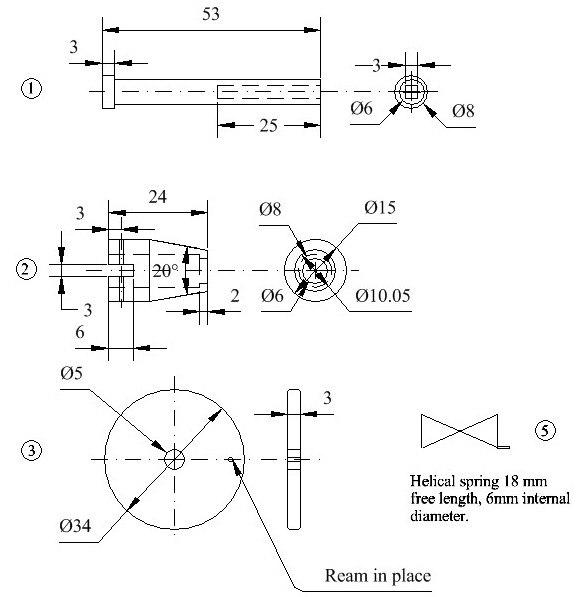
Figure 2 is a drawing of the several parts with dimensions added. These of course may need to be varied to suit a particular chronometer, but should work with the majority of chronometers made in the twentieth century. For those not used to reading drawings, the main view is a plan view and the view to the side is what one would see standing on that side looking back.

Figure 2: Dimensioned drawing of parts.

Figure 2: Dimensioned drawing of parts.

Making the shaft.

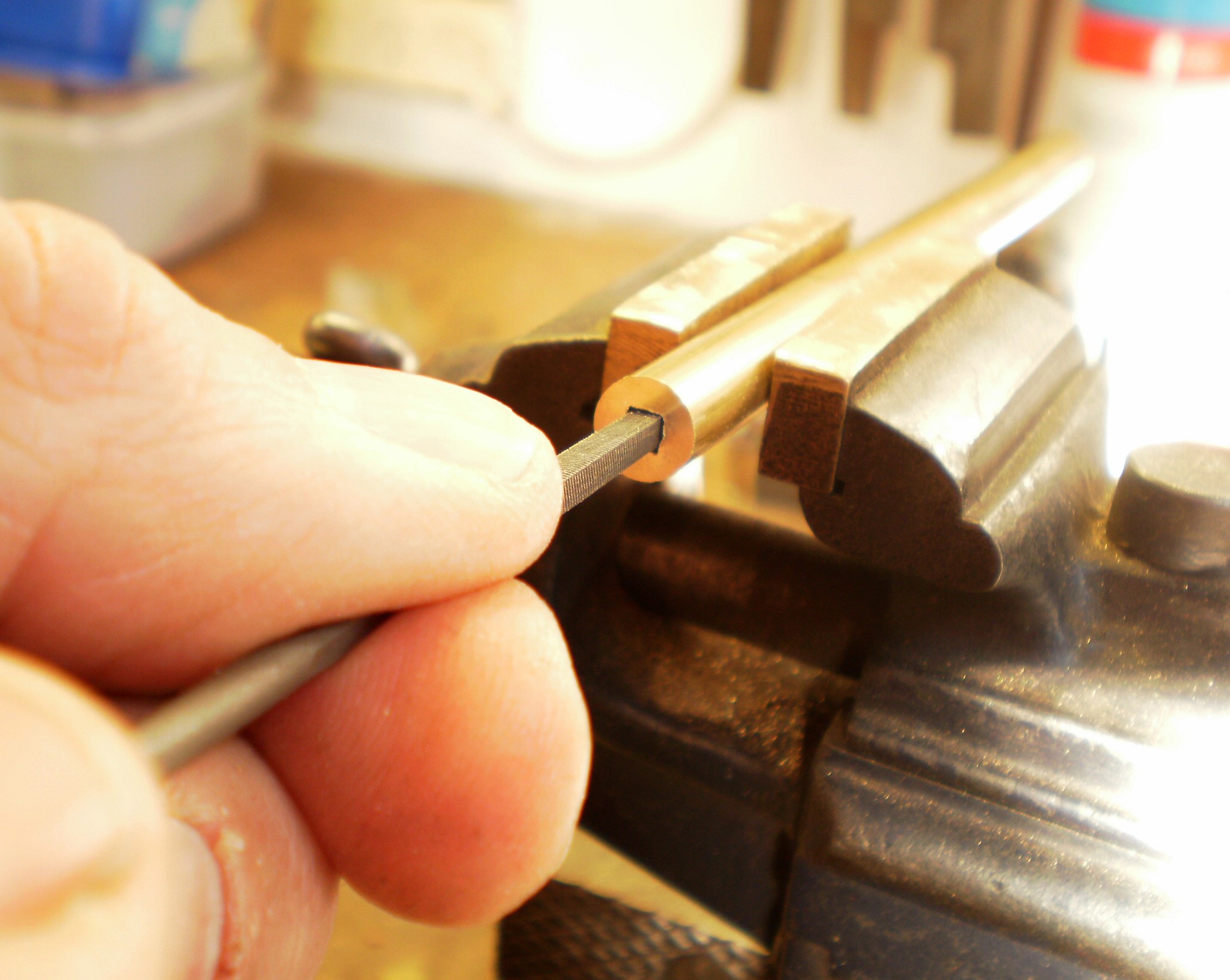
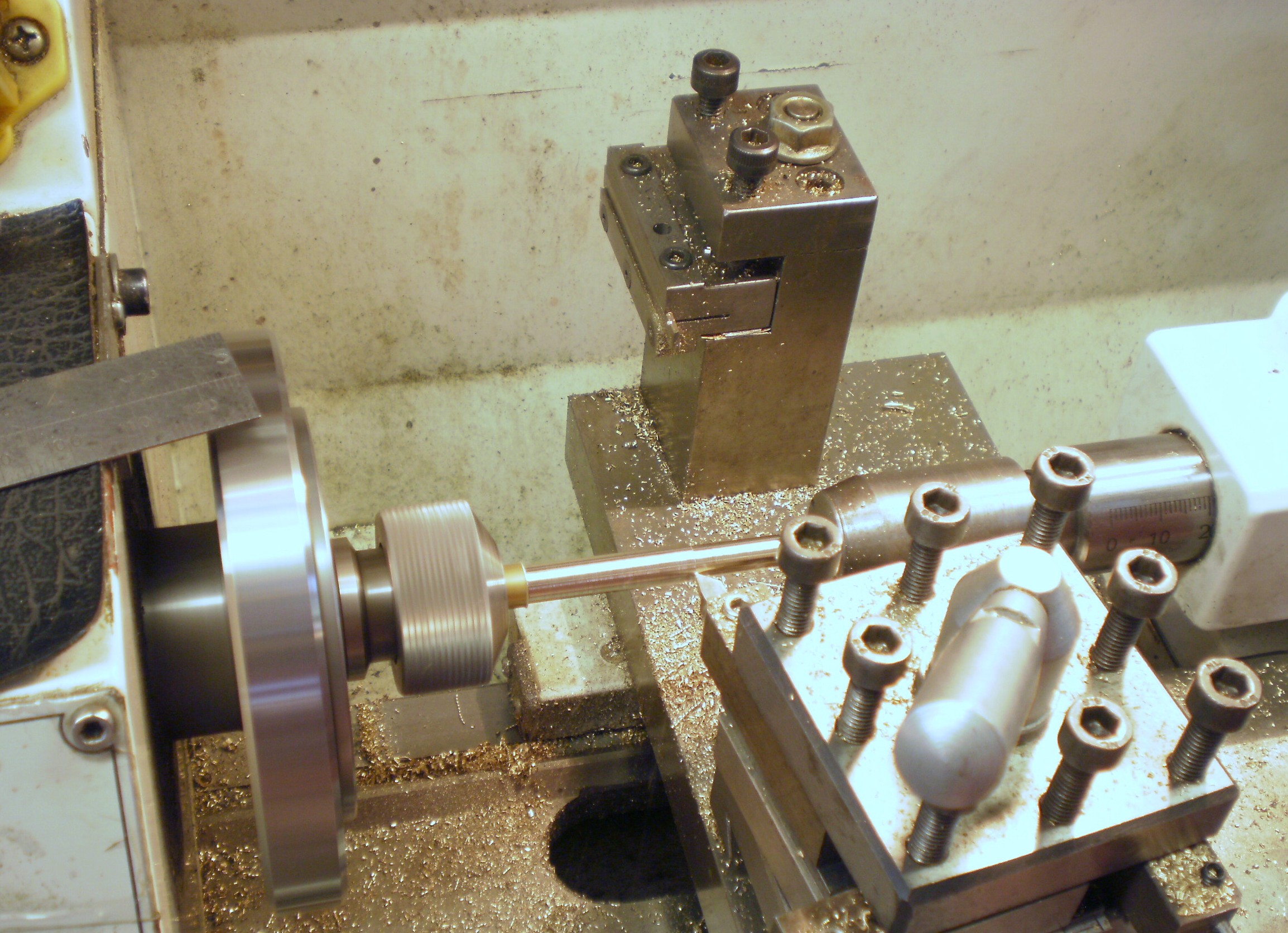
This begins by facing a length of 8 mm brass rod, centring it and drilling it to a depth of 25 to 30 mm to a diameter that is the same as the across-flats dimension of the required square (Figure 3). The rod needs to have a length allowance to allow it to be gripped securely in the lathe chuck. The deep hole allows one room to manoeuvre when converting the round hole to a square one, using a square Swiss file. You file away, using the remnants of the hole as a guide to when the square is near to size and then try it on the chronometer. Once it begins to enter, it is then simply a matter of raising the filing hand a little so that the square is deepened until 4 or 5 mm will grip the winding square (Figure 4).

Figure 3: Facing, centring and drilling.

Figure 3: Facing, centring and drilling.

Figure 4: Converting a round hole to a square one.

Figure 4: Converting a round hole to a square one.

The proto-winding shaft is then returned to the lathe, the end supported with a back centre, the 6 mm portion turned down to size (Figure 5) and the whole parted off to length (Figure 6). The diameter may of course be adjusted a little to suit available springs. Most seem to be wound anti-clockwise, so your collection of odd springs may have only a few that are clockwise helices.

Figure 5: Turning to size.

Figure 5: Turning to size.

 figure 6: Parting off.


Figure 6: Parting off.

The Body

Making the body is mainly a straightforward drilling and turning exercise, but before parting off from the parent metal, a 3 mm wide slot must be milled across a diameter for the knob (Figure 7). The home workman is more likely to use a slot drill for this, but those well equipped with a horizontal milling machine and a suitable cutter may choose to use this, though the setting up time is probably longer. Of course, the job can also be done with a saw and file.

Figure 7: Milling slot for knob.

Figure 7: Milling slot for knob.

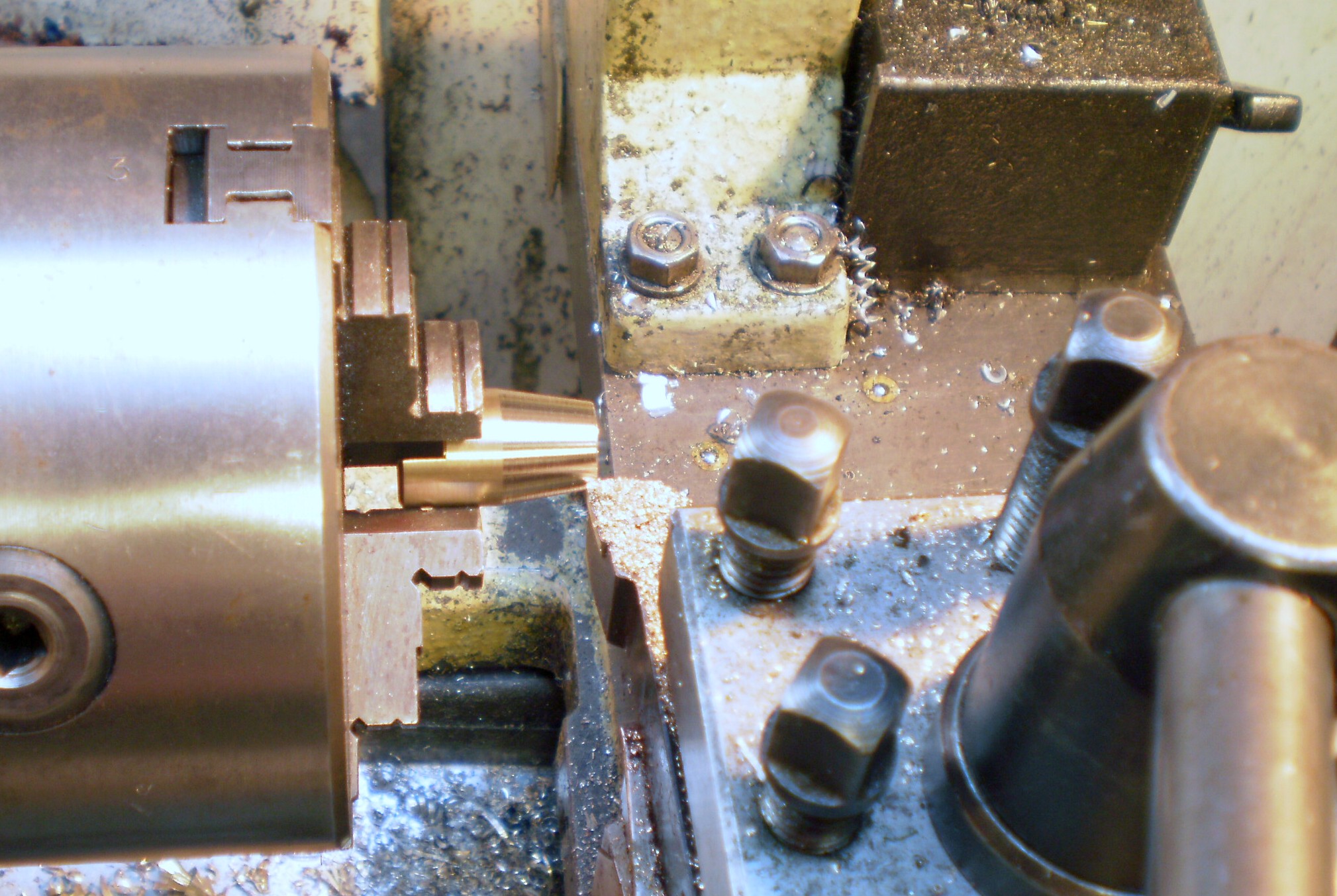
After parting off, the nose is tapered, as shown in Figure 8, taking care to taper the correct end!

Figure 7: Taper turning nose.

Figure 8: Taper turning nose.

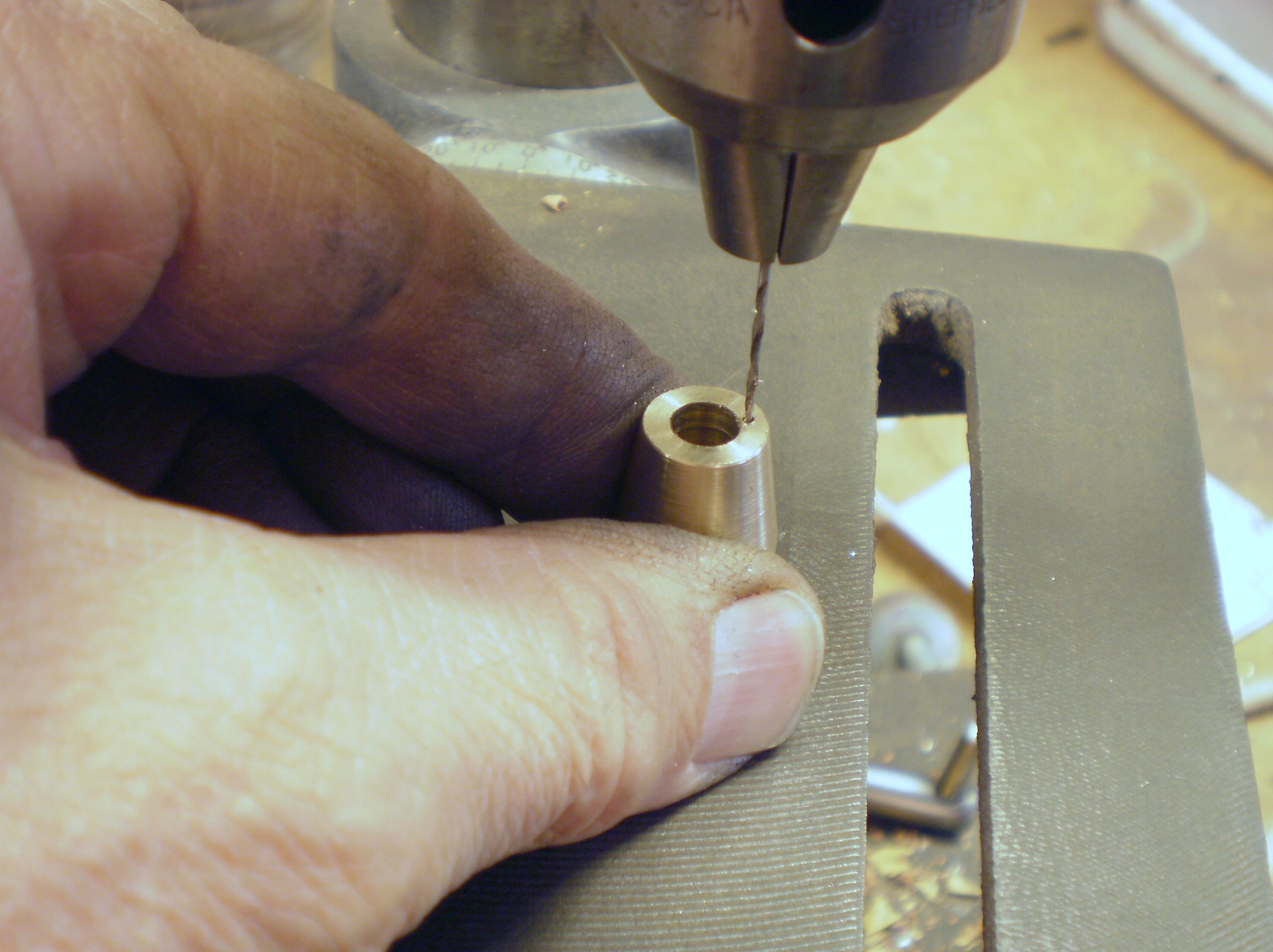
Then, using a drill of about 0.8 mm diameter, a hole is drilled which will anchor the lower end of the spring to the body (Figure 9).

Figure 9: Drilling for spring anchor.

Figure 9: Drilling for spring anchor.

The Knob

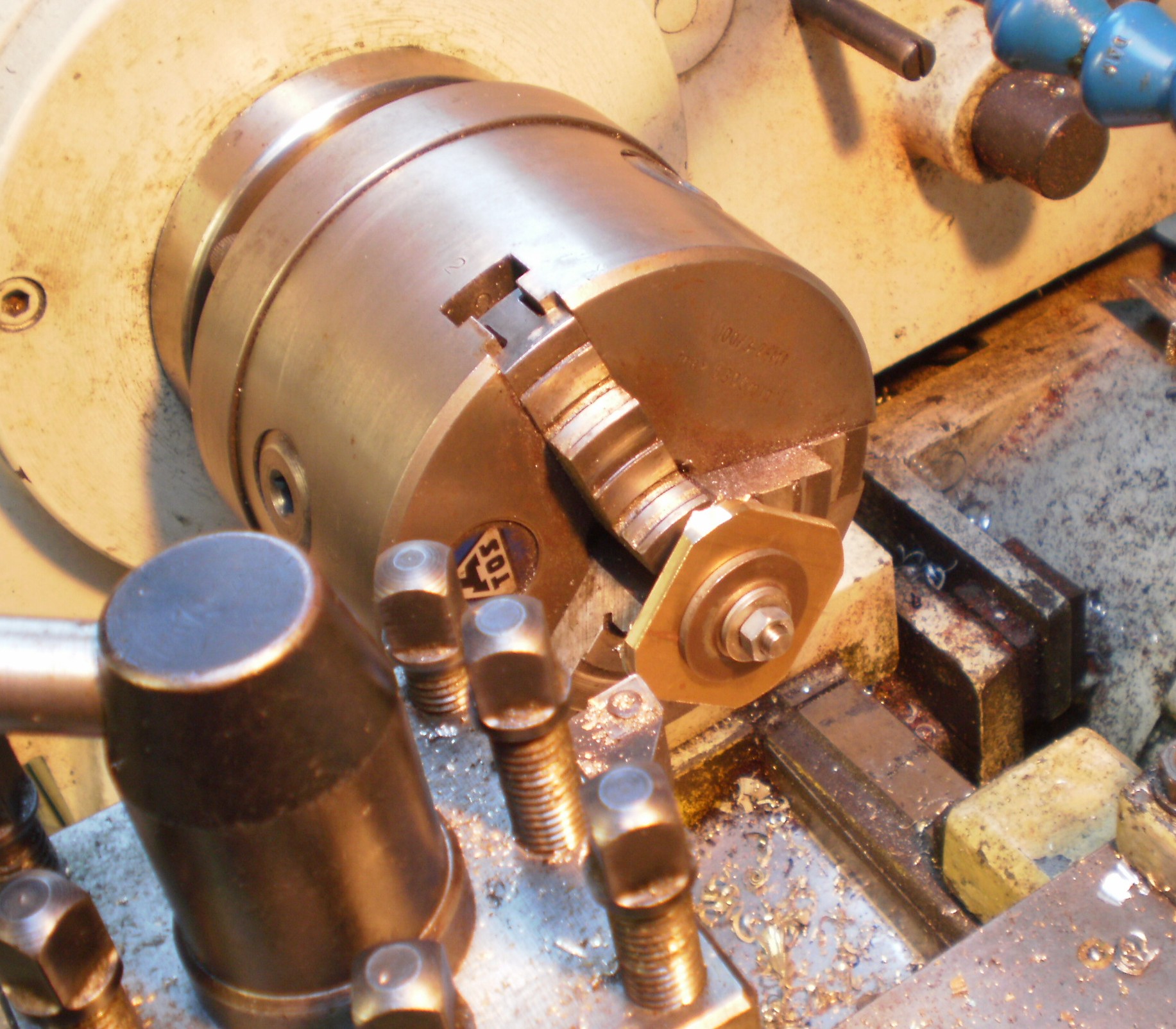
The disc-shaped knob could be parted off a brass bar 36 mm in diameter, leaving the problem of how to finish the parted off face, so it is much simpler to make it out of sheet material. Those who like exercise can saw it to approximate shape and then file it round using a suitable cheater (see previous post for a note about these useful items), but I chose the easy way of mounting a square on a mandrel and turning off the corners(Figure 10). The edges can be bevelled at the same time.

Figure 10: Forming the knob.

Figure 10: Forming the knob.

The knob is then held in the slot to be cross-drilled and reamed for a taper pin which will hold the knob in place (Figure 11). Taper pin reamers receive little use in industry these days and may be hard and expensive to find, so a parallel pin secured with a dab of industrial adhesive such as Locktite will do just as well.

Figure 12 shows the parts ready to be assembled. The compression spring shown is not ideal as the end tends to jump out of the anchoring hole, but it was the only suitable clockwise spring I could find at the time. I have since replaced it by fitting an anticlockwise extension spring over a 6 mm mandrel and unwinding it. I then cross drilled a hole in a 4.75mm (3/16 in) mandrel to anchor the end of the 0.7 mm wire and rewound the spring, clockwise.

Figure 11: Reaming for a taper pin.

Figure 11: Reaming for a taper pin.

Figure 12: Exploded assembly.

Figure 12: Exploded assembly.

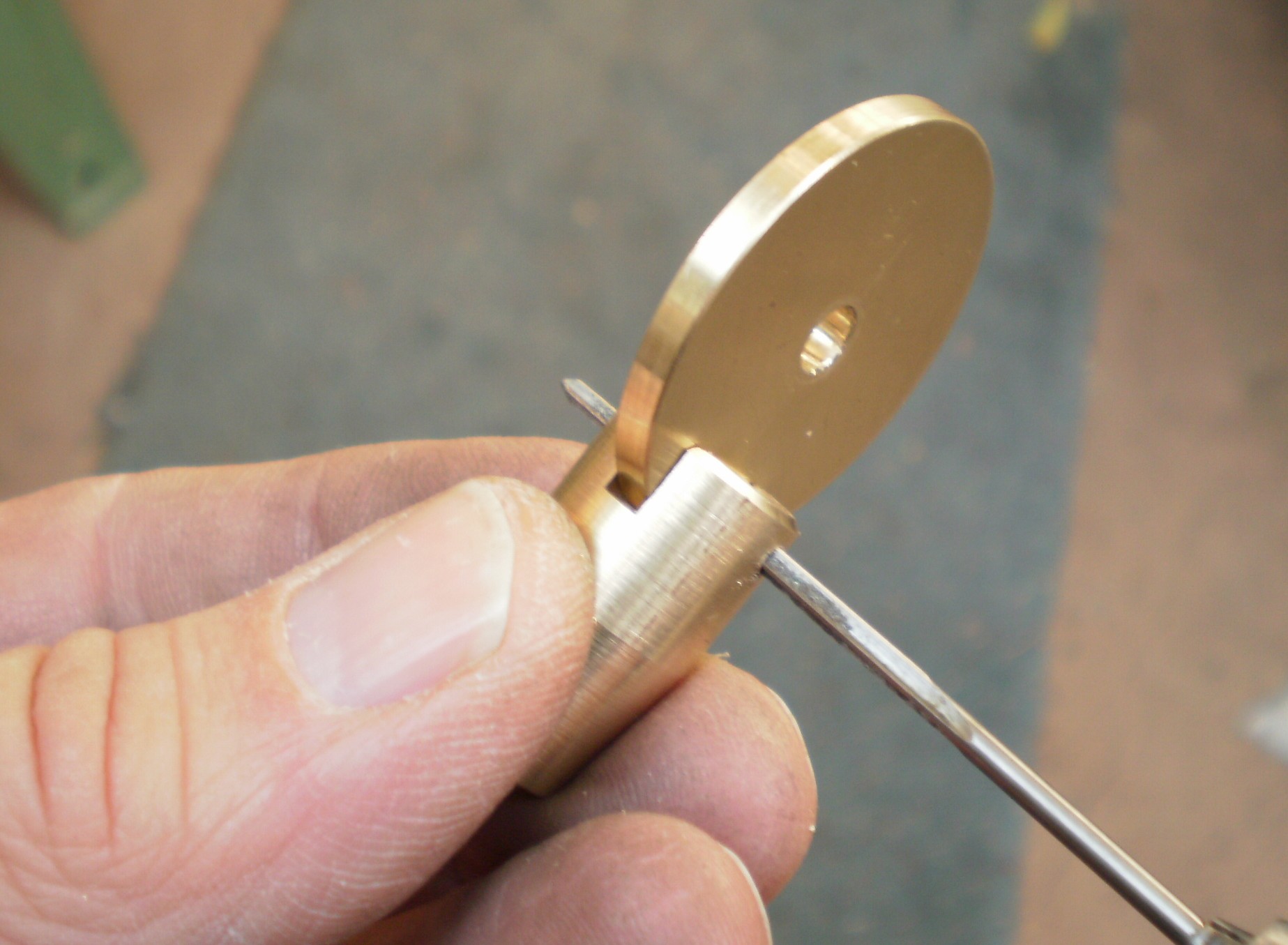
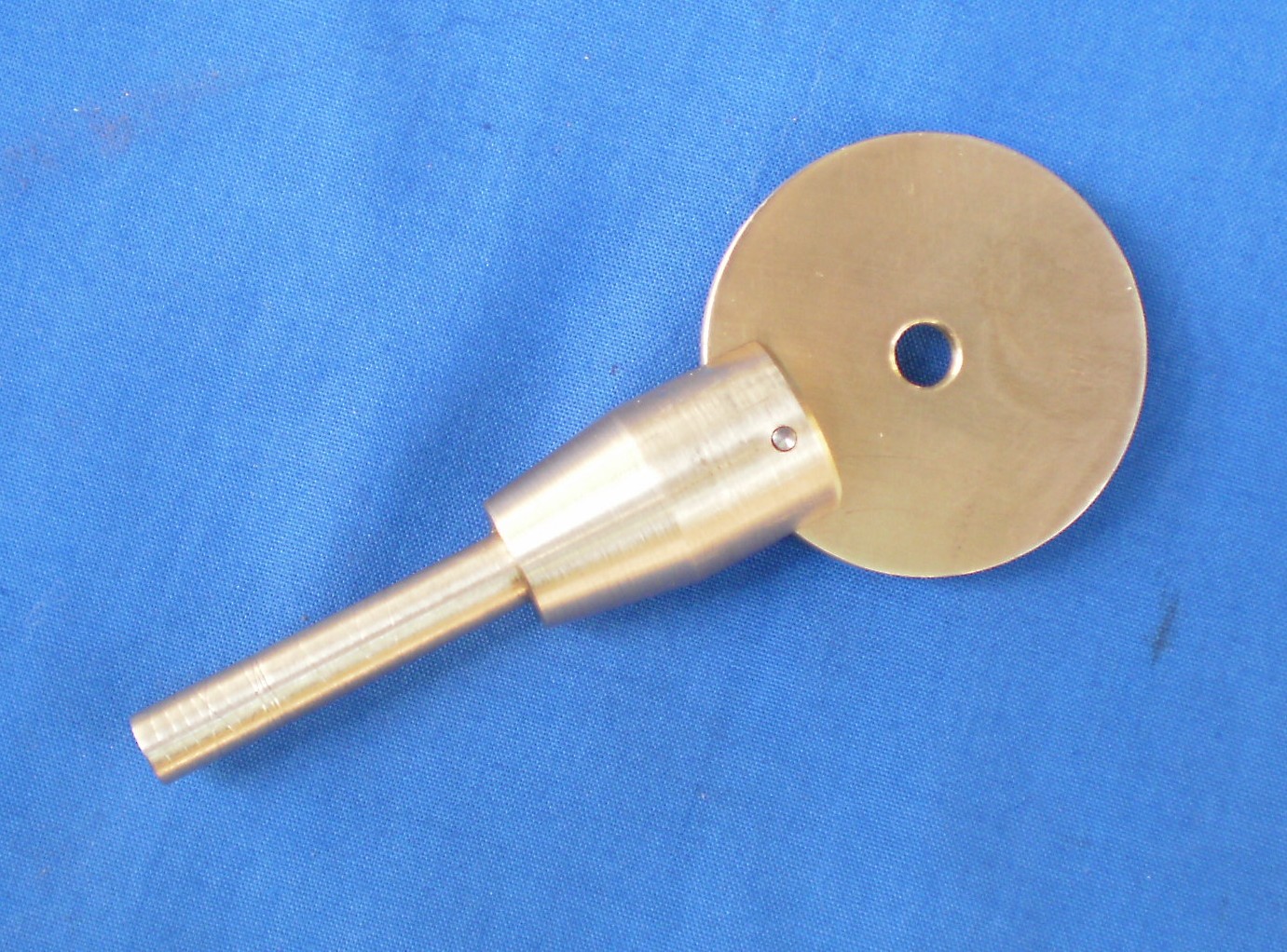
After cleaning up the parts are assembled, tapping the taper pin lightly home and sawing it off to length. A brass pin would have been ideal, but I made do with a steel one, as the chronometer it is intended for will never go to sea again. Figure 13 shows the completed key.

Figure 13: The completed key.

Figure 13: The completed key.

If you enjoy reading this or other of my posts, let your interested friends know so that I will be encouraged by visitor numbers to write more. And of course buy “The Mariner’s Chronometer” for much, much more.


7. Making a replacement lid for the case.

28 07 2013

Nearly all chronometers were supplied with a three tier case, incorporating a base, a hinged glazed lid and a hinged cover for the glazed lid. On board a ship, the chronometer was often mounted beneath a glazed part of the chart table so that the time could be seen at a glance. Where more than one chronometer was carried, they were mounted in a special case with a single lid for the (usually) three instruments. This meant that the cover for the glazed lid was superfluous and it was usually removed with its hinges and eventually lost. The lid was usually provided with brass corners. This seems to be due to tradition rather than necessity, since a chronometer was handled so carefully that it had no need of protection, unlike the nautical sextant which often was and the case of which was never provided with brasswork.

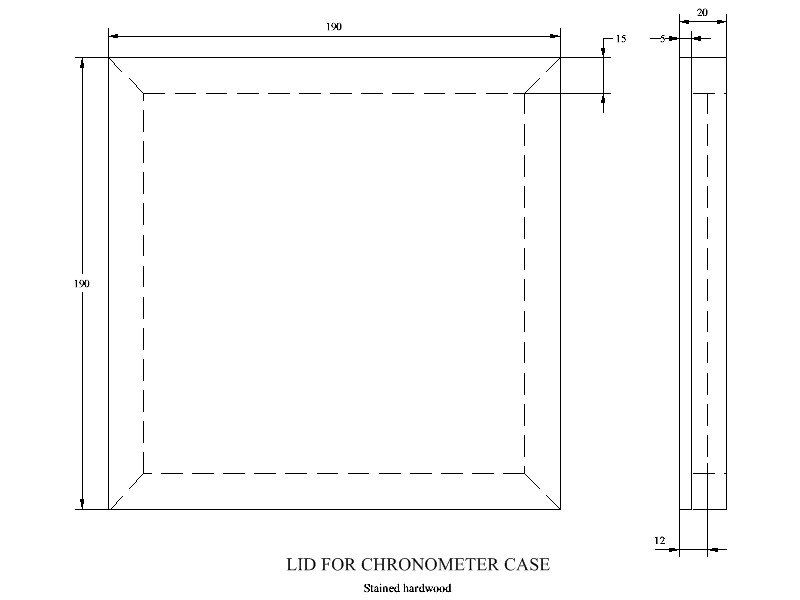
The present-day lover or collector of chronometers may wish to replace the missing lid, so this post gives some details of dimensions and shows how brass corners are made. Chronometer cases were usually made of mahogany, rosewood or lesser timbers stained to look like them. I have a precious supply of well-seasoned African sapele, but beech or birch can be stained to look similar. Figure 1 shows the structure of a typical lid with dimensions which seem to be pretty much the same  whoever the maker, but it is as well to check against the box itself (All the figures can be enlarged by clicking on them. Use the back arrow to return to the text.).

Figure 1: Dimensions and structure of lid.

Figure 1: Dimensions and structure of lid.

The lid is in two main parts, a top 12 mm thick and a frame 15 mm thick rebated and glued into the underside of the top to give a total thickness of 20 mm. Figure 2 shows the underside of the lid to make this a little clearer. I use a simple mitre joint at the corners but those with more complex wood-working equipment may chose something more complex.

OLYMPUS DIGITAL CAMERA

Figure 2: Underside of lid.

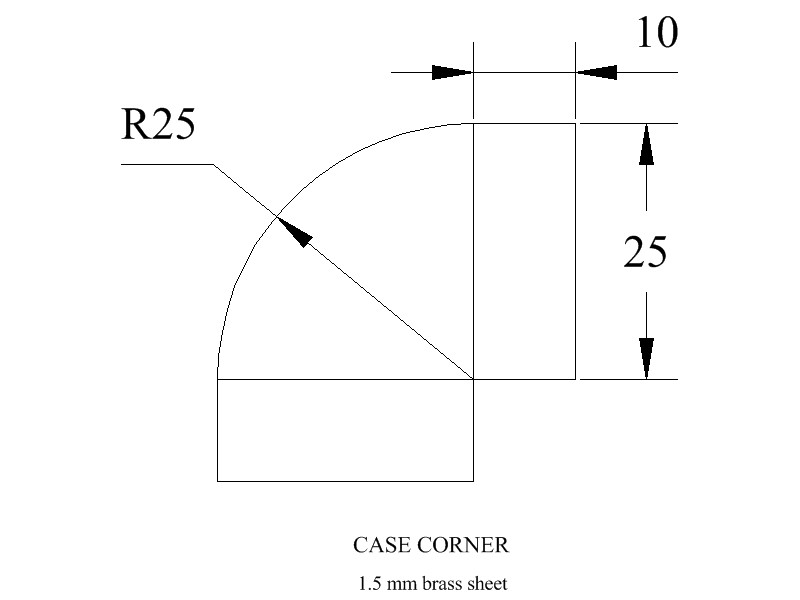
Brass corners made by simply folding thin sheet do not have crisp edges and look amateurish, while most of those that I have seen for sale are not correct to form. The metal workers of the past would have filed a 90 degree groove in the brass sheet nearly all the way through prior to folding the sheet to a right angle and running solder into the groove. There is no reason why this should not be imitated today, starting with a saw cut to locate and guide the file along the correct line and, since the result will be out of sight, all manner of scratches and false starts can be made as long as the resulting fold is in the right place and looks crisp. I find it much easier to use a shaping machine and to mark out all four corners on a single sheet of brass so that it is easier to secure on the work table of the machine. Figure 3 shows the dimensions of a single corner and Figure 4 below it shows a groove being cut in a piece of 1.5 mm brass sheet which has been marked out for two sets of four corners.

Figure 3: Dimensions of a corner.

Figure 3: Dimensions of a corner.

Figure 4: Machining grooves.

Figure 4: Machining grooves.

The tool moves backwards and forwards, cutting on the forward stroke and deepening the grove with each stroke. Care is taken not to cut all the way through. I usually leave about 0.1mm uncut. The point of the tool is formed to an angle of 92 degrees so that when the metal is folded, the slight spring of the residual metal in the bottom of the groove results in an angle of 90 degrees and also leaves a little space for the solder to run into. Once all the grooves have been cut, the curves can be sawn nearly to size and the four corners separated prior to removing the little squares of material at the centre. Figure 5 shows me using a piercing saw to separate the corners. Note that the saw is tilted forwards a little, as this seems to make sawing in  straight lines easier, but when sawing curves, the blade must of course remain vertical.

Figure 5: Separating the corners with piercing saw.

Figure 5: Separating the corners with piercing saw.

The curves may now be filed to the finished shape, either by simply filing to the marked line or, more easily, using a “cheater”. This is simply a piece of steel of the required form that can be clamped to the work piece to guide a file. Figure 6 shows one in use. When filing brass, a very sharp file is needed and one that has been used on steel will cut brass only with difficulty, so a deft touch is needed to sense when the file has cut all the brass and is sliding over the steel without cutting into it.  Notice the yellow tape on the handle of the file to remind me that it is to be used only on brass.

Figure 6: Using cheater to guide file.

Figure 6: Using cheater to guide file.

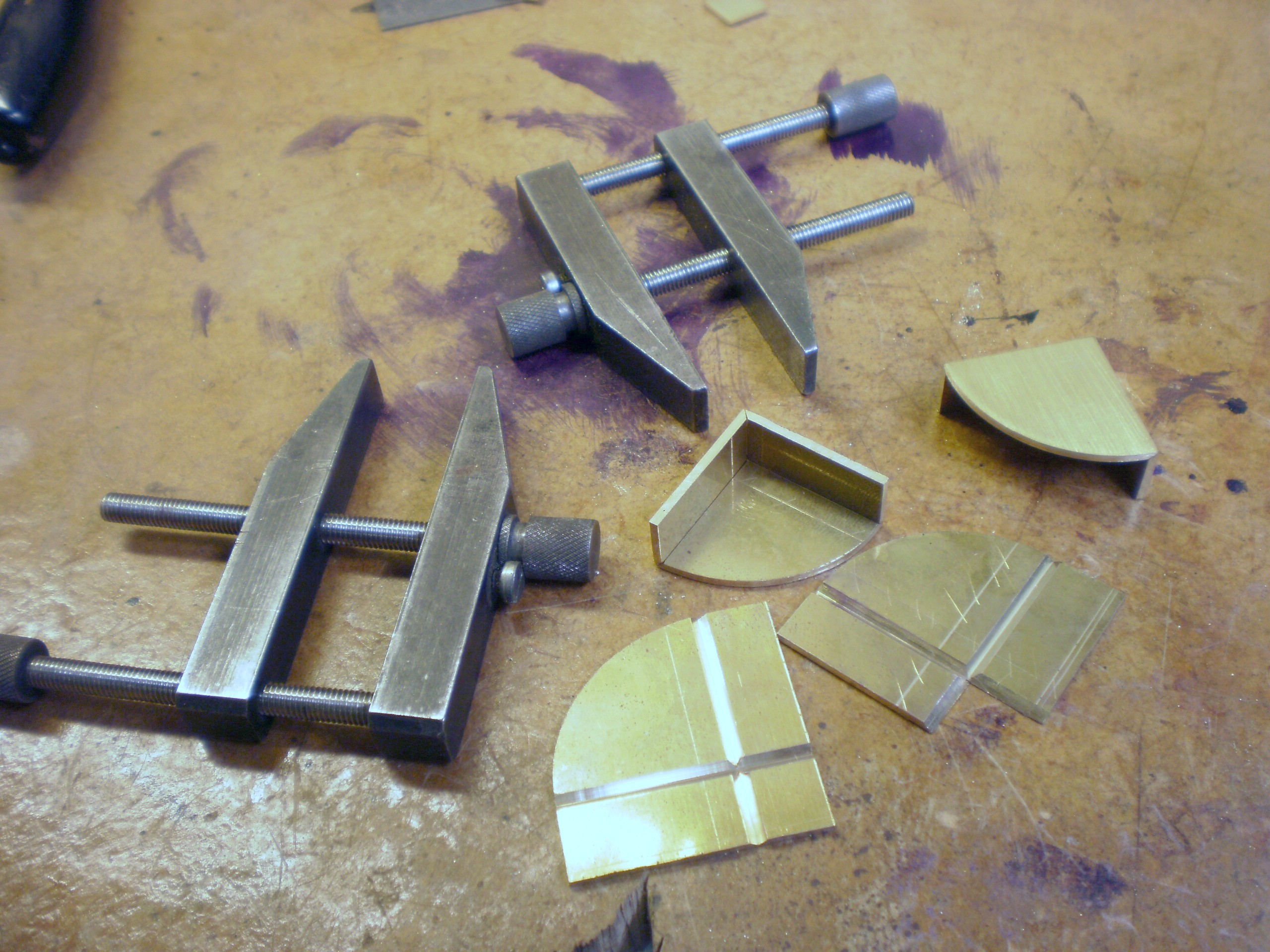
Figure 7 shows corners at various stages of formation, from bottom to top, cut out, cleaned up with square cut out, and folded ready for soldering. When cutting out the square, care must be taken to leave a little metal for cleaning up with a small file, so that a nice clean mitre is left at the corner without any line of solder showing. Once the folds have been made, check that the sides form right angles with the tops and with each other. Solder can then be run into the joints as shown in Figure 8.

Lid replacement 007

Figure 7: Stages in forming corner.

Figure 7: Soldering joints.

Figure 8: Soldering joints.

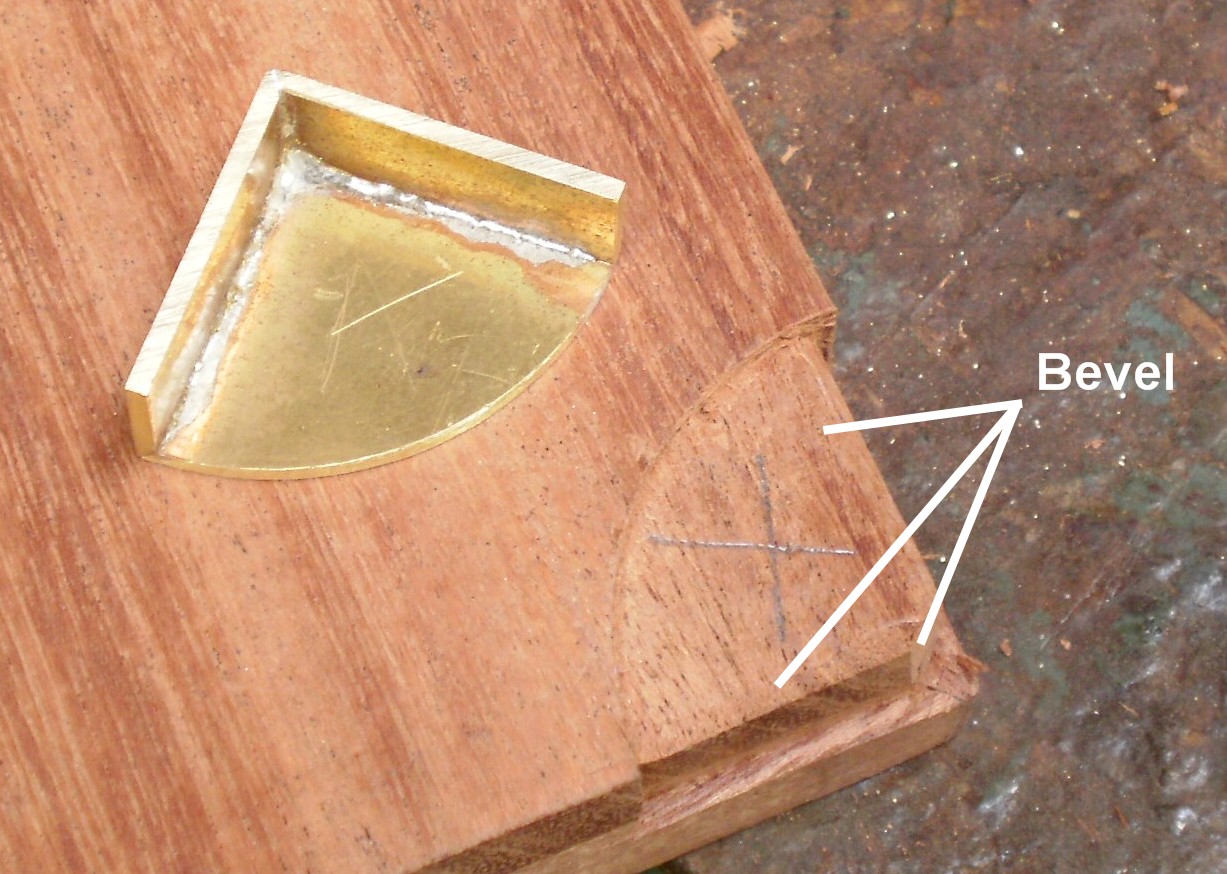
Seats for the corners must now be cut into the top of the lid. The rebates for the sides of the corners are relatively simple, though a sharp chisel is needed for cutting across the grain and care must be taken not to cause large splits at the end of the cut when doing so. Small blemishes do not matter, as the corner will conceal them. The cut-out for the curve, however, is more difficult and requires a chisel of the right curvature. Gouges of this size are expensive, especially if they are unlikely to be used again, so I made a rough chisel out of a scrap of steel and case-hardened the business end. Note that the bevel of the chisel must be on the inside of the curve. Figure 9 shows the cut made by the chisel and this provides enough guidance for a fairly narrow chisel to remove the waste wood.

Figure 8: Chisel for cutting curves.

Figure 9: Chisel for cutting curves.

Figure 10 shows the rebates finished ready to receive the corners, but first the wood must be stained and varnished to a similar finish to the rest of the case,  Originally, the corners were pinned into place with narrow brass pins whose heads were then filed off flush, but a modern gap-filling adhesive such as a two-part epoxy like Araldite makes this unnecessary. Note that the corners of the rebates must be bevelled so as to allow room for any excess solder that might otherwise prevent a snug fit. Minor fitting errors can be concealed with mahogany paste.

Figure 9: Corner ready to be fitted.

Figure 10: Corner ready to be fitted.

Figure 11 shows a completed lid. Fitting of the hinges is routine, but getting them so that the lid sits squarely is not. The rebates in the lid for the hinges can be marked out from the rebates on the glazed top and new hinges fitted to the lid. It is as well to plug any holes in the glazed top with hardwood pegs if they are likely to be anywhere that new screws are going to go. If you then roll out a thin layer of Plasticine and cut slices to place where the new hinges will go, position the lid correctly and press, the screw holes will be marked out on the Plasticine. You can then drill pilot holes through the Plasticine into the wood in the correct places and get the lid to fit correctly first time. All is not lost if the lid ends up askew. Simply drill out the screw holes in the glazed top to about 5mm and fill the holes with epoxy putty. When dry, it can be drilled for pilot holes without any danger of the screw following the grain of the wood. If you reserve the last coat of varnish until the corners are fitted, you can give the corners a coat that will keep them shiny for a good few years.

Figure 10: Finished lid in place.

Figure 11: Finished lid in place.

The Mariner’s Chronometer is for sale through www.amazon.com and its European equivalents such as www.amazon.co.uk and www.amazon.co.fr ;and this is probably the cheapest way to buy it. I have been greatly encouraged by the  reviews left by buyers. I have been making minor modifications to the book as I find better illustrations, especially in the historical section.  If you have even a passing interest in marine chronometers, I think you will find the book is well worth buying.


7. Repivoting , part 2 : an escape wheel arbor.

22 07 2013

A few weeks ago, I received a Russian MX6 chronometer that had not travelled well in a journey half-way around the world. Despite having been packed with care, partly wound and with the balance wedged, it arrived with the upper balance and the upper escape wheel pivots broken. As I had a spare balance staff by me, replacing it was without problems (see post 5: Replacing a balance staff), but re-pivoting is for me always a little nerve-racking and I am in good company as one authority on repairing has remarked that “…replacing a pivot is never a pleasure.” There is more than one way to skin a cat and in the preceding post I described how to replace a pivot by drilling down the existing arbor and inserting a new piece. The drill used is necessarily slender and if it breaks off in the hole it is practically impossible to remove or to turn away, so the surrounding arbor has to be turned away, shortening it in the process. In this post, I describe a method used by clockmakers of old to replace worn pivots, but scaled down for the much finer chronometer pivots.

In this process, a new piece is fitted over the old arbor using what was picturesquely called a “muff”. It is rather difficult to illustrate photographically and I have shown it diagrammatically in Figure 1.

Pivots 2 drwg

Figure 1: Fitting a muff.

A in Figure 1 shows the broken pivot which in B has been reduced in size by turning, for about one and a half diameters. The MX6 arbor is about 1mm in diameter and I turned it down to 0.7 mm using my improvised Jacot tool as shown in Figure  2 of post 6. Turning is made much easier by annealing the end of the arbor by heating it beyond blue to a black heat and letting it cool down, since the hardness of the arbor itself is no longer important. The heat is prevented from travelling down to the pinion by holding the shaft in a small toolmakers clamp or a crocodile clip. The muff shown in C must now be made from pivot wire or silver steel and although the latter is usually supplied annealed, it is best to make sure of it by annealing, as occasionally hard batches are encountered.

Holding the steel in a collet chuck, it is centred, in my case by using a 1 mm carbide drill which has been sharpened by the 4-facet method and is therefore self-centring. This is followed by a 0.7 mm drill to a depth of a little more than the turned down length of arbor, taking great care to back out the drill frequently, so that swarf does not accumulate in the hole and jam the drill. If it does break off, it is not a disaster of the same order as if it were to break off in an arbor, but tiny drills of this size are not cheap. The outside of the muff and the pivot is then rough turned to, say, 0.2mm oversize for the body and 0.1 mm for the pivot, before cutting off perhaps 0.5 mm over-length, reversing in the chuck and facing off to exact length by repeatedly trying it on the arbor and measuring the over-all length using a micrometer with care.

Drills seldom drill exactly down the centre line of a work piece, so to ensure that the hole and the finished outside are concentric, it is necessary to make a tiny mandrel, turned down at its end to the same diameter as the arbor and the hole, and to fit the rough-turned muff to the mandrel without removing the latter from the chuck, unless you can be sure that your chuck is accurate to very close limits. On this occasion, I heated the end of the mandrel with a soldering iron and applied a flake of shellac until there was sufficient heat to melt it, at which point I fitted the muff to the mandrel and allowed everything to cool down. This takes us to point D in Figure 1 and is shown in Figure 2, when the muff can be turned down to its finished size and the pivot burnished. Burnishing is often described as a process that both smooths and work-hardens the surface of the pivot, but with the sort of pressures that can safely be applied, it is unlikely that any work-hardening ever takes place, so the finished muff must be heat-treated to increase its hardness without too much reducing its toughness (or increasing its brittleness, which amounts to much the same thing). Since the muff, being close to the chuck, is well supported, it can be burnished without the use of Jacot tool and it is helpful to hold the burnisher under the pivot so that progress can be monitored more easily until the pivot appears to have an even polish. Application of the soldering iron then releases the pivot from the mandrel.

Figure 2: Finish turning muff.

Figure 2: Finish turning muff.

As the pivot is now only 0.2 mm in diameter, heating it directly in a flame to harden it may cause it to flare up to white heat and disappear, so I buried mine in a little pile of case-hardening compound (Kasenit) on a fire brick and heated it slowly until it melted all around my muff, when I brought it to red heat and decanted the bleb of compound into cold water. The compound protects the steel from oxidation and in this instance also refines the grain structure near the surface, reducing the likelihood of cracking in service. It is now very hard, but brittle, so must be tempered to increase its toughness. The easiest (and safest) way is to use a domestic oven turned up to 260 degrees Celsius (500 F). I polished the end of the mandrel to witness the tempering colours and fitted the muff to the end as a convenient way of not loosing a tiny piece of steel barely 2 mm long and 1 mm in diameter. As a precaution, I also monitored the temperature with a thermocouple thermometer. After tempering for 30 minutes and allowing the parts to cool, I then cemented the finished muff to the arbor, again using shellac. I have used Locktite in the past, but to make it release its grip it needs to be heated to a much higher temperature than shellac, which melts at about 140 Celsius, so any heat treatment of the adjacent metal is put at less risk with shellac.

Figure 3 shows the finished product. The tempering colour is just visible, a dark brown verging on purple, so it is harder than ordinary blue pinion wire and than the deep wine colour recommended by Marvin Whitney in his “The Ships Chronometer”, but as it shows the degree of toughness and hardness used in the past for punches and reamers, it should stand up well to service in the chronometer. I have left the tempering colours on the body of the muff as a witness to the repair for any future servicer of the instrument.

Figure 3: Hardened and tempered muff fitted to escape wheel arbor

Figure 3: Hardened and tempered muff fitted to escape wheel arbor

Although the muff appears to be of larger diameter than the tapered rest of the arbor, it is in fact 1.01 mm in diameter, and the escape wheel boss fitted over it without problems. It remained only for it to be fitted to the chronometer. It was a trifle over length, so I reduced it by about 0.01 mm using a diamond lap so that there is now barely discernible end play in a freely running wheel and the chronometer is performing as it should.


6. Re-pivoting a Balance Staff, Part 1

9 06 2013

In Post  number 5 I showed how to replace a damaged balance staff and in this post I show how to re-pivot the badly cut staff. Figure 1 shows the pivot together with its dimensions.

Figure 1 : Cut pivot

Figure 1 : Cut pivot

The traditional way of re-pivoting would use a lathe with the staff held in a collet and the staff steadied using a Jacot tool. A graver would be used to turn off the damaged portion and a centre for a drill started using the point of the graver. A hole would then be drilled using a spade drill and a slightly tapered piece let into the hole until it jammed in place in the hole. The pivot could then be cut off to length and finished to size using a graver. This process has scarcely changed in two hundred years, but small machine tools and their attachments are now much better constructed than they were even fifty years ago and it seems to me that we should take advantage of advances. In any case, I am nearing the end of my days and have not the time to learn skills which have been made largely obsolete by modern tools. Professionals who read what follows may disagree with my method, but it does use the skill that has been built into the lathe and employs the lathe slides that can guide a tool far better than I could by hand. It is important, however, that the cutting edge of the lathe tool should be exactly on centre height and this is best achieved by making trial cuts on a piece of pinion wire, closely observed with a magnifying lens.

The first step is to soften the end of the staff by heating. To prevent the heat from travelling too far from the end, it is convenient to hold the staff in a small tool-maker’s clamp as a heat sink and to pass the end of the staff briefly through a gas flame until tempering colours have made their way 3 or 4 mm down the staff. By clicking on the figure to enlarge the image, these colours can be seen in Figure 2 , which shows the staff held in a modern collet chuck and steadied in a home-made Jacot tool (most Jacot tools were made for watchmaking and are too small to accommodate a chronometer staff).  The latter has a variety of holes of different sizes drilled very accurately on the centre line of the lathe.

Figure 2 : Facing end of staff.

Figure 2 : Facing end of staff.

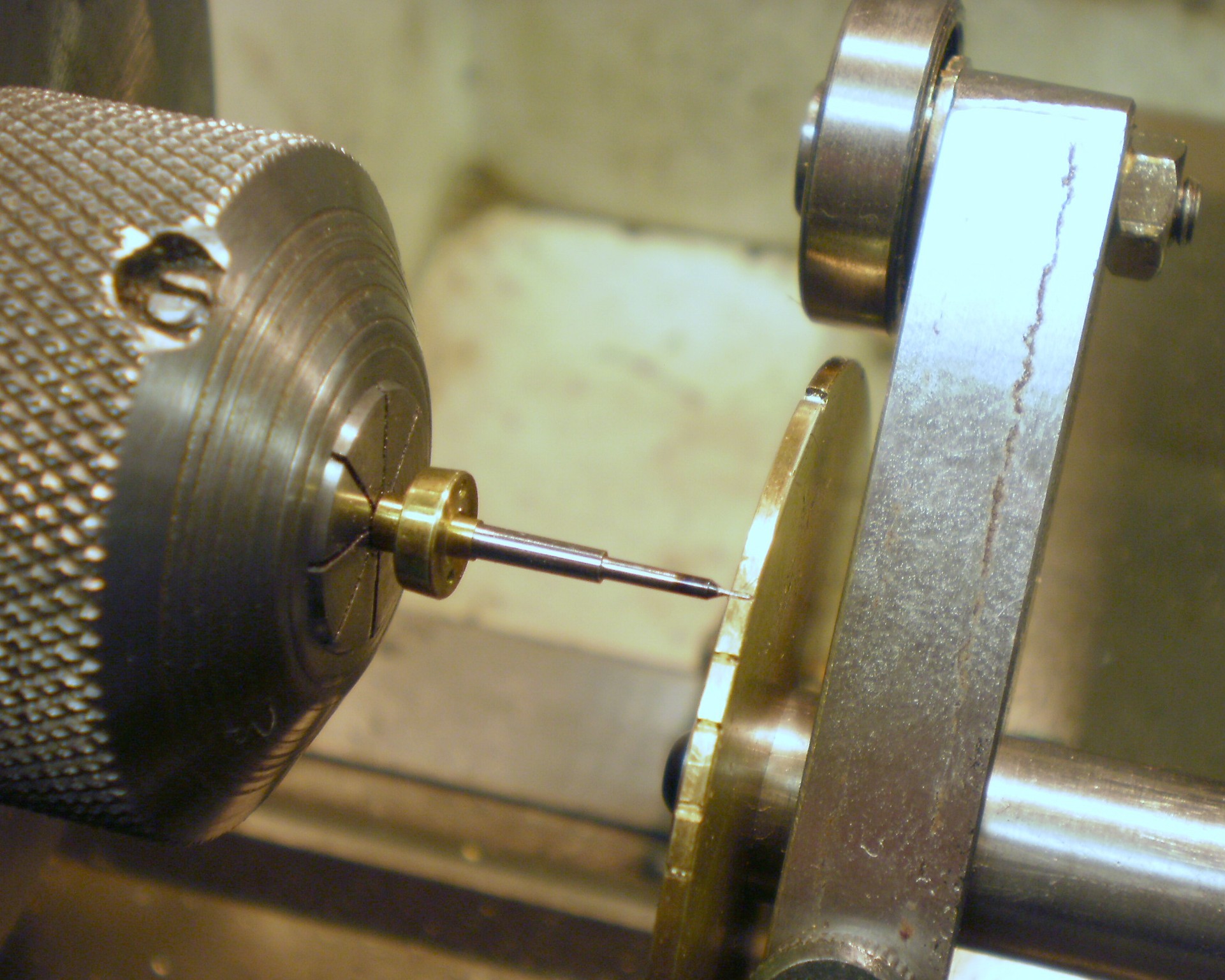
Once the end of the staff has been faced square using the cross slide of the lathe, the Jacot tool can be replaced by a drill chuck and a centre started. Even the smallest standard centre drill is too large for this task, but modern small solid carbide drills are ground by the four facet method and so are self centring.  I used a relatively large 1 mm diameter drill to remove the merest shaving from the centre to provide a true start for the smaller drill to follow (Figure 3). If this step is omitted, the end of the smaller drill is liable to wobble about off centre and eventually break off.

Figure 3: Centring end of staff.

Figure 3: Centring end of staff.

Once a true start has been made, the smaller drill can follow, in this case of 0.45 mm diameter , as shown in Figure 4. A very delicate touch is needed. Marvin Whitney recommended holding the drill between the fingers in a small pin chuck, but if care is taken to keep the drilling under constant observation with a magnifying glass and to frequently withdraw the drill to clear away swarf, the normal feed arrangement provided in the tailstock can be used safely. A depth of three to four drill diameters should be deep enough.

Figure 4 : Drilling to size.

Figure 4 : Drilling to size.

A start can now be made on the insert. Whitney recommended English sewing needles whose temper had been drawn to a “wine” colour. This corresponds to a temperature of about 280 degrees Celsius, a little lower than for normal pinion wire which tends to be blue and therefore a little softer. However, English darning needles are hard to come by so I used Swiss pinion wire, hardened and re-tempered to a dark purple (wine?) colour, turning it down to fit the hole drilled in the staff (Figure 5).

Figure 5: Turning down pinion wire.

Figure 5: Turning down pinion wire.

Modern industrial adhesives have made interference fits almost a thing of the past. I used Loctite to secure the new pivot in the hole and after letting it cure, returned to the set-up of Figure 2 to turn it down to length and diameter, followed by burnishing. This is a finishing process which, as well as smoothing and polishing the pivot, to some extent may also work harden it (I seriously doubt that work hardening takes place at the pressures possible). A glass-hard burnisher is drawn across emery paper to make very fine transverse grooves and the burnisher is then pressed on to the pivot and drawn across it as it rotates. The pivot has to be supported while this is being done and my home-made Jacot tool is provided with a disk which has a variety of semicircular and vee grooves cut into the periphery (Figure 6). Prior to burnishing the end, I rounded it using a fine file. Note the use of a ball race to support one end of the burnisher and to keep it parallel to the axis of the workpiece. It then remained only to polish off the tempering colours from the staff, purely for cosmetic reasons

Figure 6: Support for the pivot while being burnished.

Figure 6: Support for the pivot while being burnished.


5. Replacing a balance staff

16 04 2013

Clicking on the figures will provide you with an enlarged view. Use the back arrow (top left corner) to return to the text.

Recently, a Kirova MX6 chronometer, which had been keeping a very good rate within half a second a day, began to have a very irregular rate, sometimes amounting up to six seconds a day, so it was plainly time for an overhaul. The irregularity could have been due to variations in power, though by now the conditions required for an isochronous balance spring are well understood. If a balance is isochronous, it means that its period of oscillation  does not vary with the amplitude of oscillation. However, since the instrument plainly needed attention, I checked for causes of loss of power due, say, to a dry mainspring or rusted links in the fusee chain, but these areas seemed to be fine. I removed the mainspring and replaced the grease anyway, and checked each link of the chain for free movement. The chain too received a good clean and some fresh lubricant. The wheels and pivots of the train were also checked for defects.

When it came to the balance staff, I found one or two pieces of cotton fibre, visible only under a microscope and sticky, thickened oil which had spread from the upper balance pivot on to the shaft of the staff. After cleaning it up, it was then just possible to see with the naked eye that there was a groove in the upper pivot and this can be seen in Figure 1, which shows the isolated staff, with a scale of millimetres above, to give some idea of how it compares in size with a pocket watch staff. It is obviously much bigger and more robust, and so easier and safer to handle than the latter (you can enlarge the photos by clicking on them).

Figure 1 : Balance staff

Figure 1 : Balance staff

As an aside, when examining things like staffs under a microscope, it helps to make a little jig, assembled from pieces of microscope slide, to hold the part horizontal. In the jig on Figure 1, I glued two uprights to a slide, having first filed vee notches in the uprights to prevent the staff from rolling off. Thus under control, the mechanical stage of the microscope can be used to move the slide around for systematic examination. Figure 2 shows the condition of the upper pivot with dimensions added. A pivot diameter of around 0.2 mm is common for chronometers, while pocket watches typically are under 0.1 mm.

4 Cut pivot

Figure 2: Cut upper balance pivot.

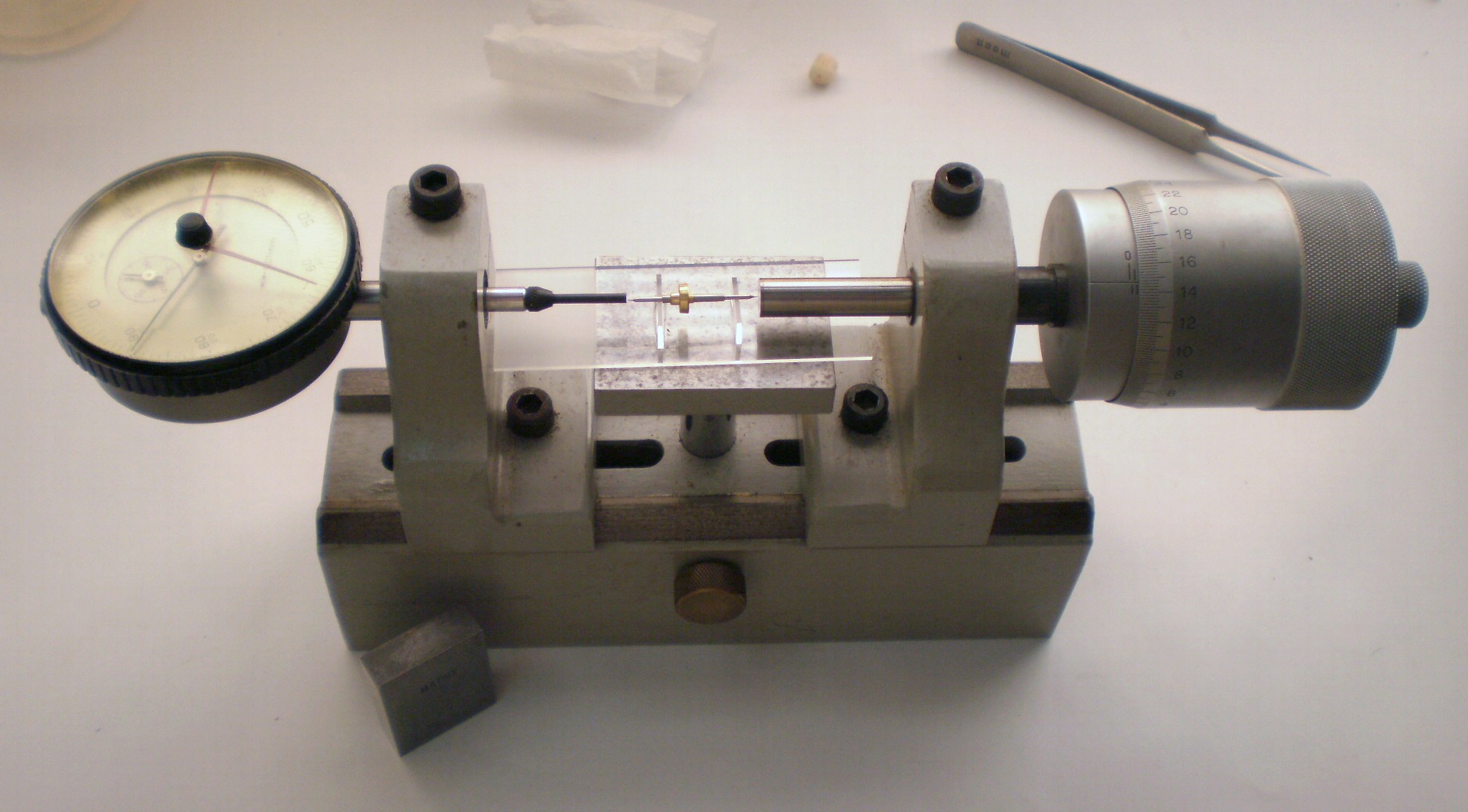
Plainly, something is very wrong, as the pivot is “cut”, maybe as the result of rough handling or careless assembly causing the hole jewel to be chipped or cracked or perhaps due to defective heat treatment of the staff. However, the staff shown is hard chromium-plated and, although I could see no defect in the jewel, I replaced it anyway. For the staff there were three options of increasing difficulty: to replace the staff or re-pivot the existing one or make a whole new one, and as spare parts are still occasionally available for this type of chronometer, I took the easy way out and simply replaced the whole staff. Figure 3 shows the over-all length of the staff being checked using a bench micrometer. The dial indicator on the left is set to zero against a slip gauge, seen at bottom left, with the micrometer reading zero. When measuring a part, the micrometer head on the right is rotated until the indicator again reads zero and the reading on the micrometer head is added to the length of the gauge.

Figure 3: Checking new staff for length.

Figure 3: Checking new staff for length.

To make matters easier, it is helpful to take  photographs or make sketches of the relative positions of the balance spring and the rollers so they can be replaced in the same positions. Figure 4 shows the balance from above with a line added to show the position of the upper balance spring stud. The timing nuts are at three and nine o-clock. The lower balance spring collet is split as shown at about 8 o-clock to allow adjustment. To remove it from the tapered shaft, insert the tip of a screw driver into the split and rotate it while drawing it upwards. If it doesn’t want to move upwards, pry gently from below.

Figure 4: Angular position of balance spring

Figure 4: Angular position of balance spring\

Figure 5 shows the angular positions of the discharge and impulse pallets and rollers. Note that the acting faces are radial and that the discharge pallet is much smaller and therefore it is harder to be exact about its position. The position of the balance spring stud is shown by the white line. It is about 180 degrees from the impulse pallet and the latter is about 80 degrees from the discharge pallet. The balance wheel is removed after releasing two countersunk screws and stored safely with the spring.

Figure 5: Angular positions of impulse and discharge jewels.

Figure 5: Angular positions of impulse and discharge jewels.

This then allows an approach to removal of the rollers, but first it is wise to check the longitudinal position of the discharge pallet. The end of that shown in Figure 6 is resting on the face of the impulse roller and the act of removal may cause it to jump out of its slot. It is as well to be prepared for this and perhaps save many anguished minutes looking for a tiny sliver of ruby. If it does fall out, it is a simple but ticklish job to re-shellac it into place and I will perhaps cover this in a future post. Note the flat on the roller. This makes adjustment using a close-fitting wrench easier.

Figure 6: Impulse roller and jewel.

Figure 6: Impulse roller and jewel.

Figure 7 shows the rollers and staff set up in a roller removal jig. That shown is simply a piece of 6 mm steel with a vee slot cut into it and the face of the vee relieved to a suitable thickness such that the vee will fit between the impulse roller and the balance wheel collet. A light, sharp tap with a hollow punch that fits over the pivot will usually cause the staff to drop out of the rollers, and it can then be put away safely to await re-pivoting.

Figure 7: Roller removal.

Figure 7: Roller removal.

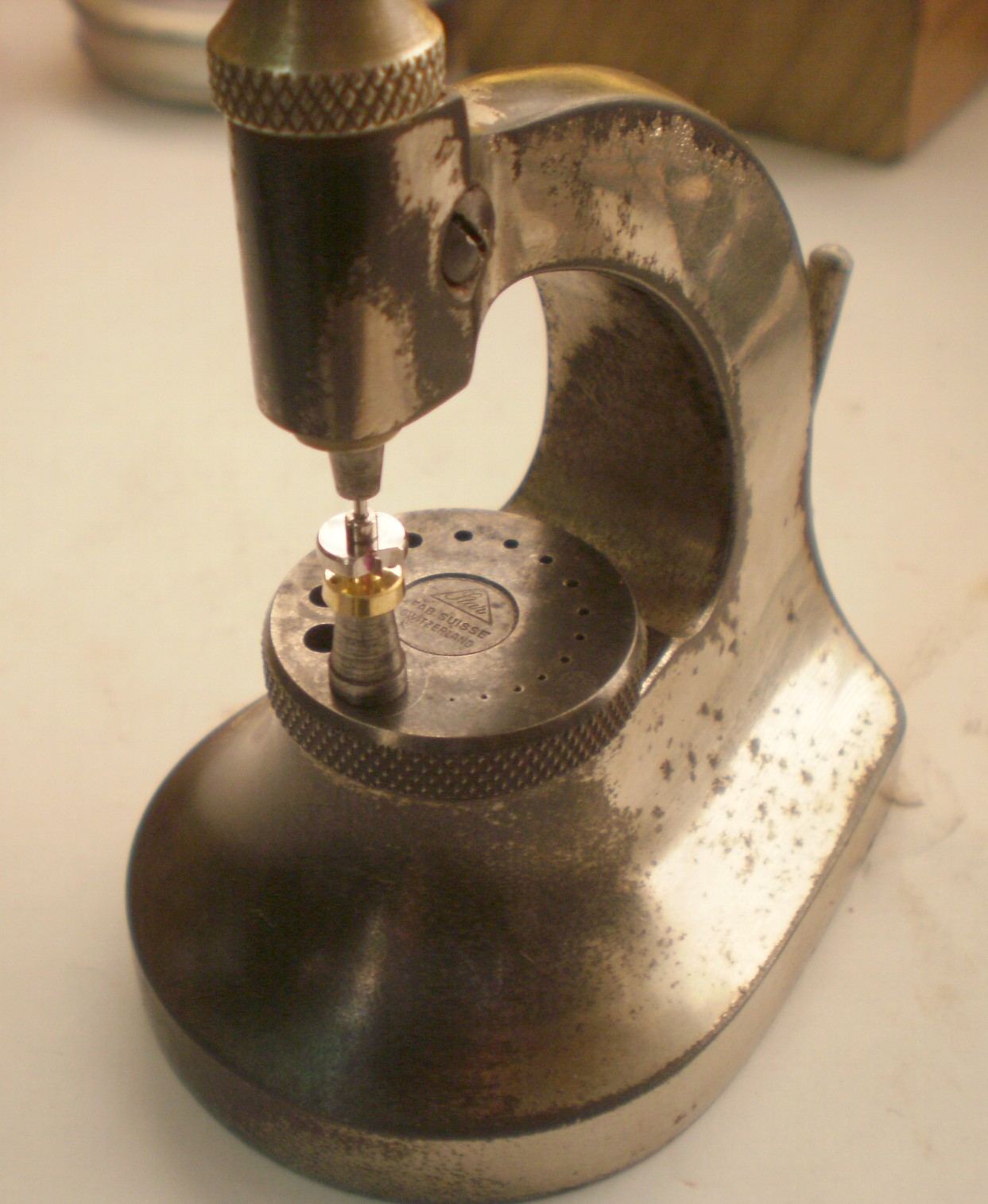
The balance wheel is then attached to the new staff so that the rollers can be replaced in the correct angular relationships. Figure 8 is a posed photograph without the obscuring wheel, to show how the staff is set up on a stump in a staking tool with a hollow punch pressing the rollers back into place. They should not be hammered into place, especially not the discharge collet, as doing so may split it as it is forced down the taper of the staff.

Figure 8: Posed replacement of rollers.

Figure 8: Posed replacement of rollers.

Once the wheel and rollers are back in place, hopefully in the correct angular relationships, the balance may be poised as shown in Figure 9. Poising is perhaps less important in a chronometer than in a watch, since a chronometer is always face up with the balance staff vertical, but it is worth paying attention to detail with such a precise machine. There is a variety of  poising instruments including those with adjustable ruby knife edges on a mounting with a spirit level, but a pair of truing calipers used as shown in Figure 9 seems to serve as well, at less expense. One or other of the timing nuts (not the compensation weights) is adjusted until the wheel shows no tendency to come to rest at any particular position

Figure 9: Poising the balance.

Figure 9: Poising the balance.

It then remains only to replace the balance spring and refit the balance in the chronometer. At rest, according to most authorities (and there is precious little in print) the discharging jewel should be resting on the front face of the passing spring, just about to release a tooth of the escape wheel, but in the MX6 it is at rest about 10 degrees on the other side of the passing spring. Any adjustment to the lower spring collet alters its relationship to the discharge and impulse pallets. The position of the latter should be such that it and the escape wheel tooth are moving at the same speed when the tooth catches up with the pallet. If the angle is too little, the pallet may miss the tooth altogether and if it is too great, there may be insufficient impulse given.

Details of the action of a chronometer escapement are given in great detail in Chapter 2 of The Mariner’s Chronometer and some advice about its adjustment is in Appendix 1. I may attempt a systematic account in a future post. An alteration to any part of the escapement affects other parts and it is easy to go around in circles.


4: Hamilton Model 21 Escapement

12 04 2013

Note that figures may be enlarged by left clicking on them. Return to the text by clicking on the back arrow at top left.

At the end of the First World War, the United States of America had the largest of any navy, with nearly half a million personnel. A period of retrenchment followed the Treaty for the Limitation of Naval Armament of 1919 but in 1934, as world tensions seemed to be increasing, a program of ship building began to bring the US Navy up to the maximum size allowed by the London Naval Treaty of 1930. The Naval Act of 1938 contemplated a 20 % increase in building and the Two Ocean Navy Act led to a further 11 % increase, but this was soon followed by a plan to increase tonnage by 70 %, equivalent to 200 more ships. At that time, there were no manufacturers of chronometers in the USA, though there were firms that assembled them from imported parts and movements. The total annual world output of chronometers was probably in the region of 300 a year, principally from Britain and Switzerland. At the outbreak of the Second World War on 2nd September 1939, these sources became unavailable. Britain needed all her own chronometers while Switzerland, surrounded by belligerents, was soon to find that de facto limitations were place upon whom she could supply.

When WWII began, the US Navy had 394 ships of all types and by the war’s end she had 6,768, many of which  required chronometers, two or more for larger ships, one of more for smaller ones and navigational watches for vessels like patrol boats. The Hamilton Watch Company of Lancaster, Pa. was, among others, invited to commit to manufacture of the necessary chronometers and expressed interest in a letter of 2nd July, 1940. The Company was then provided with two Swiss Ulysse Nardin chronometers to examine. E W Drescher  said he thought Hamilton could make the instruments provided that certain design modifications could be made to allow mass production and the first order was placed on 16 May 1941. This accounts for the “1941” that appears on the face of the chronometer. It is not the date of manufacture but of the design. The first deliveries began on 27 February 1942 and 58 had been delivered by the year’s end, rapidly increasing thereafter, so that 8902 had been delivered by the end of the war. In most respects, the Model 21 chronometer closely followed the Ulysse Nardin design, except for a revolutionary balance design and the use of a pre-formed Elinvar-type balance spring, to obviate the time consuming and somewhat intuitive spring adjustments previously necessary.

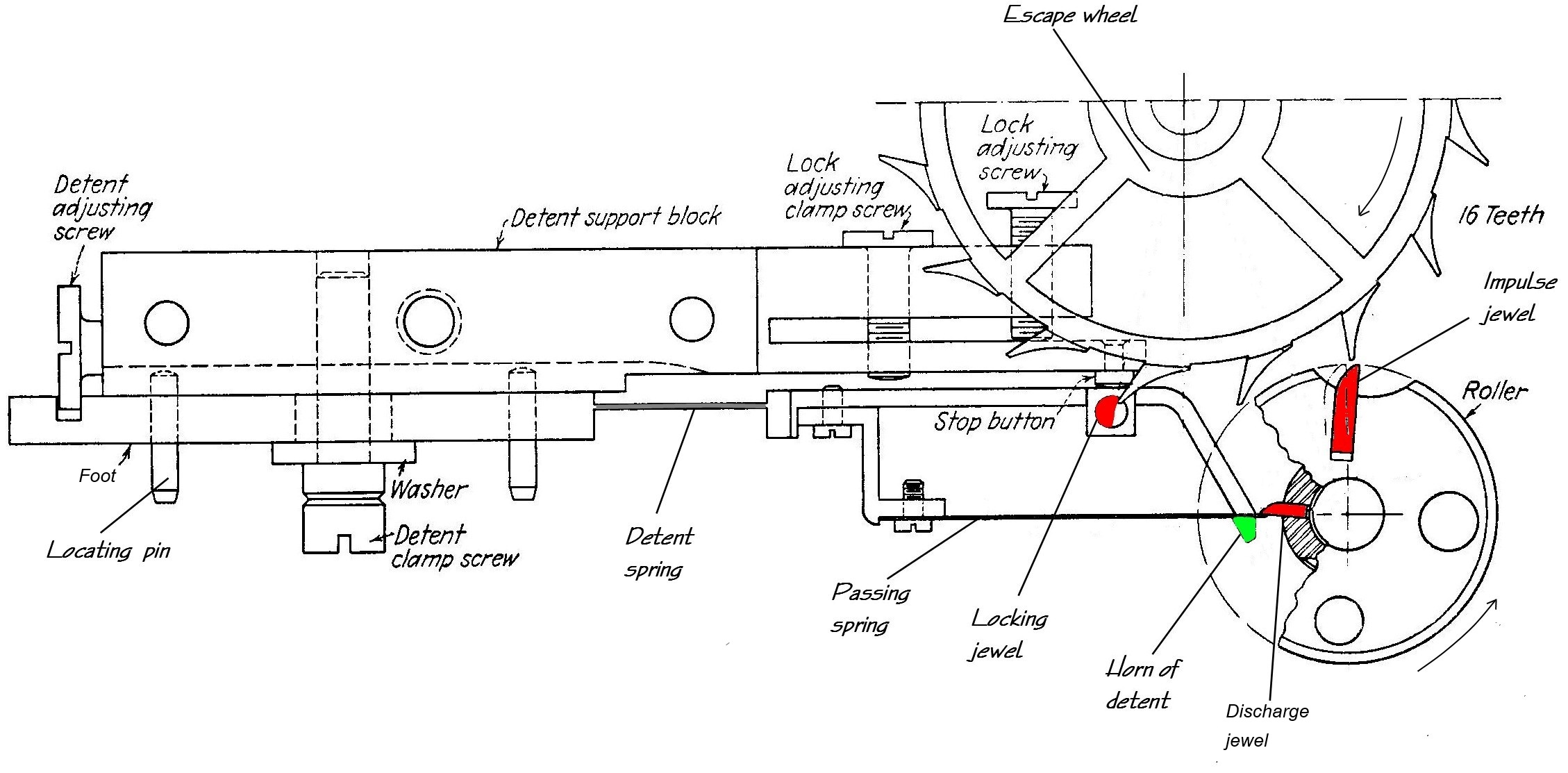
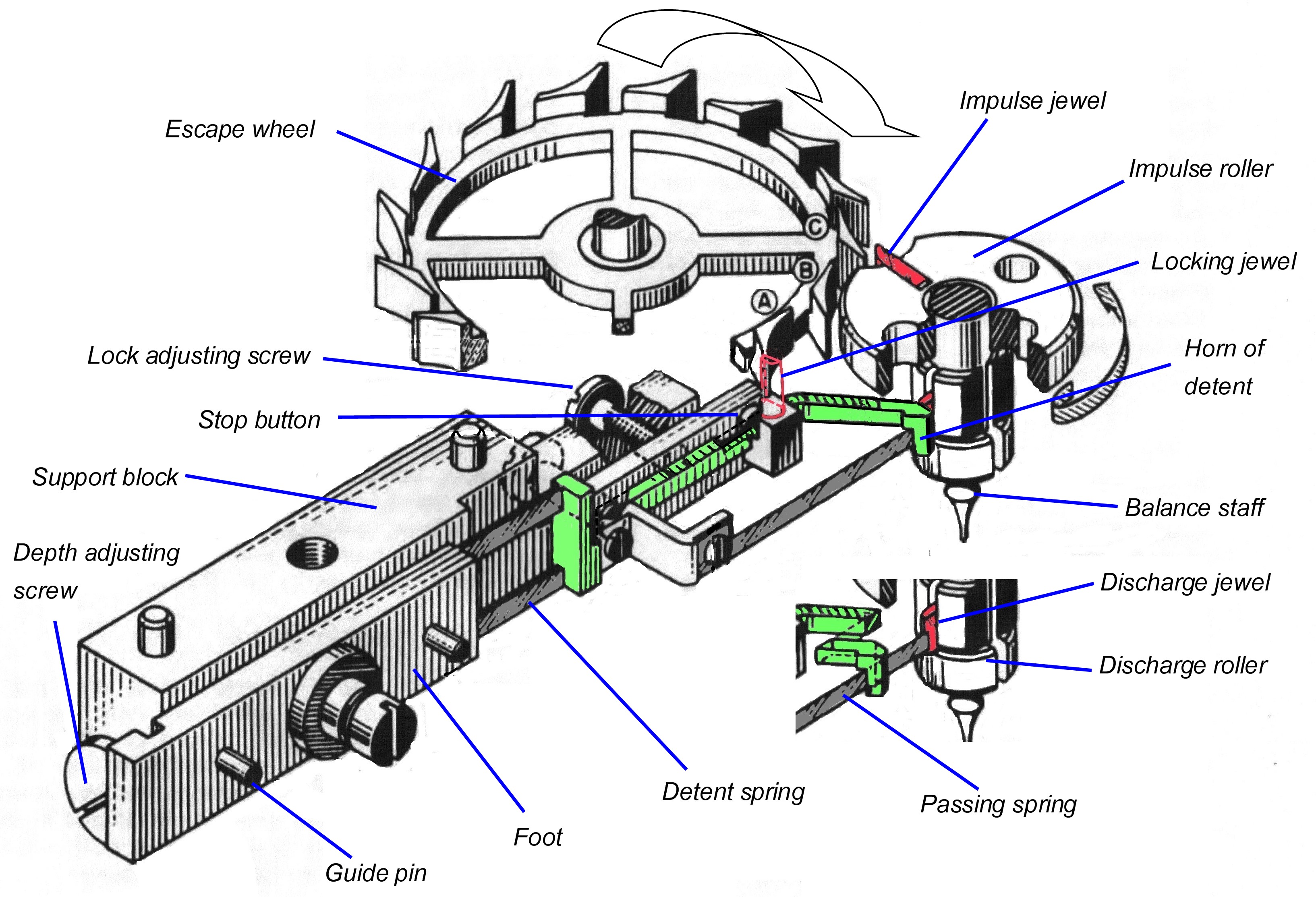
Thus it came about that the escapement design is that of Nardin and uses a slightly more complex detent than that of the standard Earnshaw spring detent used by practically every other maker. The escapement is the part that communicates with the movement and lets it run down in equal steps while the movement gives up energy via the escapement to keep the balance wheel oscillating. A plan view is shown in Figure 1 and a perspective view in Figure 2, and you may find it helpful to refer back and forth between the two diagrams while reading the explanation. In Figure 2, modified from a figure in the official overhaul manual, the horn of the detent obscures some details of the discharge jewel and so in the inset, the horn has been displaced so this can be seen.

Figure 1: Plan view of escapement (After Rawlings)

Figure 1: Plan view of escapement (After Rawlings)

The escape wheel, driven by the movement, rotates in clockwise steps. The impulse and discharge rollers and their attached jewels are mounted on the balance staff, below the balance wheel and they are shown rotating anticlockwise. In both diagrams the discharge jewel is pressing on the end of the passing spring which in turn is pressing on the horn of the detent. Upon further anti-clockwise rotation, the detent will move its attached locking jewel out of engagement with tooth A of the escape wheel, leaving it free to rotate. Meanwhile, the discharge jewel slips free of the passing spring, allowing the locking stone to fall into the path of tooth B, ready to lock the escape wheel again, and the rollers continue their anti-clockwise rotation. Tooth C catches up with the impulse jewel, delivering some energy to the balance wheel to keep it going, and then tooth B arrives at the locking jewel and the rotation of the escape wheel is arrested.

The balance wheel and the rollers eventually reach the end of their anti-clockwise rotation and return, clockwise, but this time the discharge jewel simply lifts the delicate passing spring off the horn of the detent and continues past to complete the clockwise rotation before returning to recommence the cycle. Thus, when listening to a chronometer going, one hears a loud tick as an escape wheel tooth is locked against the locking jewel and a much softer tick as the passing spring drops back on to the horn of the detent. Unlocking, impulse and locking occur only once per full oscillation back and forth of the balance wheel and for the rest of the time the it is free of interference or detached.

Figure 2: Perspective diagram of escapement

Figure 2: Perspective diagram of escapement

The structure of the detent is most easily seen in Figure 2 and a photograph of an isolated detent is shown in Figure 3.

Figure 3: Model 21 detent.

Figure 3: Model 21 detent.

A foot is attached to a support block with a screw and washer. Two guide pins engage in a groove in the support block and allow only longitudinal movement when the depth adjustment screw is turned. This adjustment determines how deeply the passing spring engages with the discharge jewel, which in turn determines for how long the locking jewel is lifted out of the path of the escape wheel teeth. If it is out of engagement for too long, locking on the next tooth may fail and the chronometer is said to trip. It will then go twice as fast as it should. The support block allows the detent to be removed from the chronometer and replaced without disturbing its adjustment in relation to the rest of the escapement.

The detent spring in the Hamilton Model 21 is in two parts, unlike most chronometers which have a simple leaf spring, typically about 0.04 mm thick by 2 mm wide. Having two parts cannot be to allow a thicker spring to be used, as the stiffness of a spring varies directly as its breadth and as the cube of its thickness. Possibly it was felt that the increased effective breadth resisted torsional forces better. In any case, the spring must be stiff enough to resist buckling as the escape wheel tooth locks on the locking jewel while being weak enough so as not to interfere significantly with the balance wheel when unlocking.

The slender and flexible passing spring is mounted on a Z-shaped bracket. However, it must not be so flexible that it cannot cause unlocking, nor should it be so strong that on resuming its seat on the horn of the detent the percussion causes the locking jewel to release a tooth. The lock adjusting screw determines the position of the stop button which in turn determines how deeply the locking jewel engages with the escape wheel teeth. It must be deep enough to lock despite any shake in the escape wheel bearings. Depth of the passing spring and lock, and the angular position of the discharge jewel in relation to the impulse jewel are interdependent; if any one is disturbed, the others may need to be adjusted to regain an efficient action of the escapement. The official Manual for Overhaul, Repair and Handling of Hamilton Ship Chronometer explains in detail how to carry out adjustments for the Model 21 and Appendix 1 of my The Mariner’s Chronometer does so for chronometers in general. Without a clear understanding of the action of the escapement and the effects of individual adjustments, one is best advised to leave well alone, and if the instrument has fallen out of adjustment through wear or accident, expert help and wide experience may well be required to put it right.


3. Hamilton Model 21 chronometer: Getting started

11 04 2013

Note that all illustrations in the blog may be enlarged by clicking on them; and reading of the text may be resumed by clicking on the Back arrow (top left)

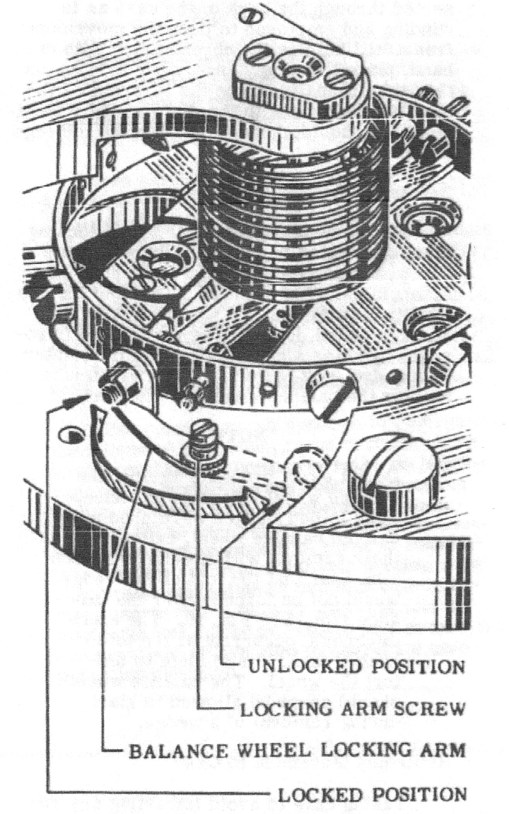
I have described in “Getting started” how to remove wedges from the balance of a chronometer of standard design and at first the Hamilton watch company immobilised the balance for transport the same way. By the time that the official Manual for Overhaul, Repair and Handling” of the Hamilton Model 21 chronometer was published in 1948, a new method of immobilising the balance was being fitted to chronometers by the US Navy, as the chronometers became due for overhaul or repair. This locking arm is shown in Figure 1.

Figure 1: Balance locking arm

Figure 1: Balance locking arm

To lock the balance the locking screw is loosened and the locking arm swung until the hole in it traps a large timing nut on the balance rim, when the screw is re-tightened. Unlocking is the reverse of locking. Although this places the balance and its pivots at less risk than when inserting wedges it was still possible for the ham handed to cause damage, and it was still necessary to remove the instrument from its gimbals and open the case. At some time after 1948, a balance locking fork was fitted as chronometers were overhauled, allowing the balance to be unlocked without opening the case. If on inverting the chronometer a small hole in addition to the winding hole is present in the dust cover, a fork is probably fitted, provided the movement is in its own case. Figure 2 shows  the hole and on rotating the cover, the socket of an Allen screw is revealed, before the winding square comes into view in its own hole

Figure 2: Locking balance

Figure 2: Locking balance

If the original key is absent, any 1/16th inch AF (across flats) Allen key will do to loosen or tighten the screw and, as the screw is captive, you need not fear that you will over-tighten it and damage the movement or unscrew it completely so that it gets lost in the works. Figure 3 shows the fork itself. There are two soft plastic pads on the ends of the arms and when the screw is tightened against the springy stem, the pads bear on the balance rim and bring it to a halt.

Figure 3: The locking fork.

Figure 3: The locking fork.

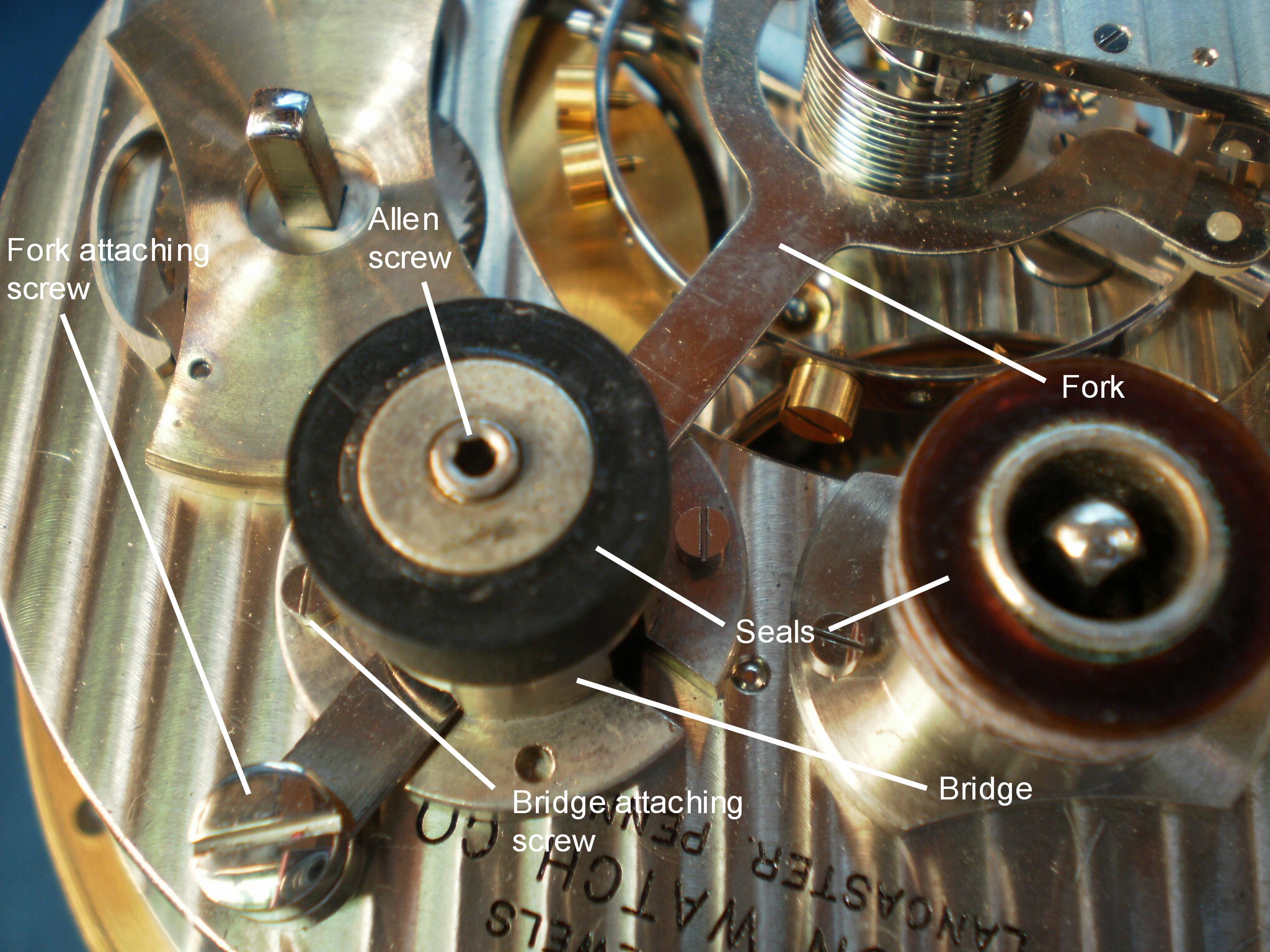
When servicing a Hamilton Model 21 chronometer, the fork and the bridge that straddles it have to be removed before the upper balance cock and balance can be removed. As Figure 4 shows, the bridge is attached to the plate by two screws, while the fork itself is secured with a single screw. Once the bridge has been removed, the fork is supported with tweezers while its attaching screw is removed.

Figure 4: Attachment of the locking mechanism

Figure 4: Attachment of the locking mechanism

By 1970, 13,086 Model 21 Chronometers had been produced, about 11,000 of them for the US Navy, the US Maritime Commission and the US Air Force during WWII. The majority of the ones I have seen are fitted with the locking fork.


2. Getting started

31 03 2013

Marine chronometers don’t like being moved around. This may seem to be a strange statement to make about instruments that spent their working lives on bridges of ships at sea, so it needs some explanation. When the balance wheel is oscillating back and forth it is unconnected with the rest of the chronometer for most of the time and it is only when it is releasing a tooth of the escape wheel or receiving a push (“impulse”) from it via the escapement that the two are connected. If the instrument is suddenly rotated at the wrong time, two teeth of the escape wheel may be released instead of one (“tripping”) or the impulse jewel may be struck amiss or the detent damaged (you can read  in the book about how these parts work). The main message of this paragraph is that moving a chronometer around needs care. It is particularly vulnerable to damage if it is fully run down, so it should be moved when it is at least partially wound, as this keeps the escape wheel locked in the correct position. If it is to be transported it should be partially wound and the balance wedged unless it is going to make only a short trip in your hands or resting on your knees. When carrying it from one place to another move deliberately and avoid sudden rotational movements as, for example, when turning to close a door behind you.

How to wind a chronometer may seem to be a mystery. No key or keyhole is visible on the front, and on the back, there is a hole, but it seems to have a dead end. Let us start, however, with the key. A chronometer must not be wound clockwise (nor should the hands ever be turned backwards) so it is provided with a key called a tipsy key that will only allow anti-clockwise rotation Figure 1). If it is turned clockwise, a clutch should slip, so begin your acquaintance with the instrument by checking that this does indeed happen when you hold the stem of the key and turn the handle clockwise: sometimes the clutch mechanism gets clogged with dirt or rust.

Figure 1 : A Tipsy key.

Figure 1 : A Tipsy key.

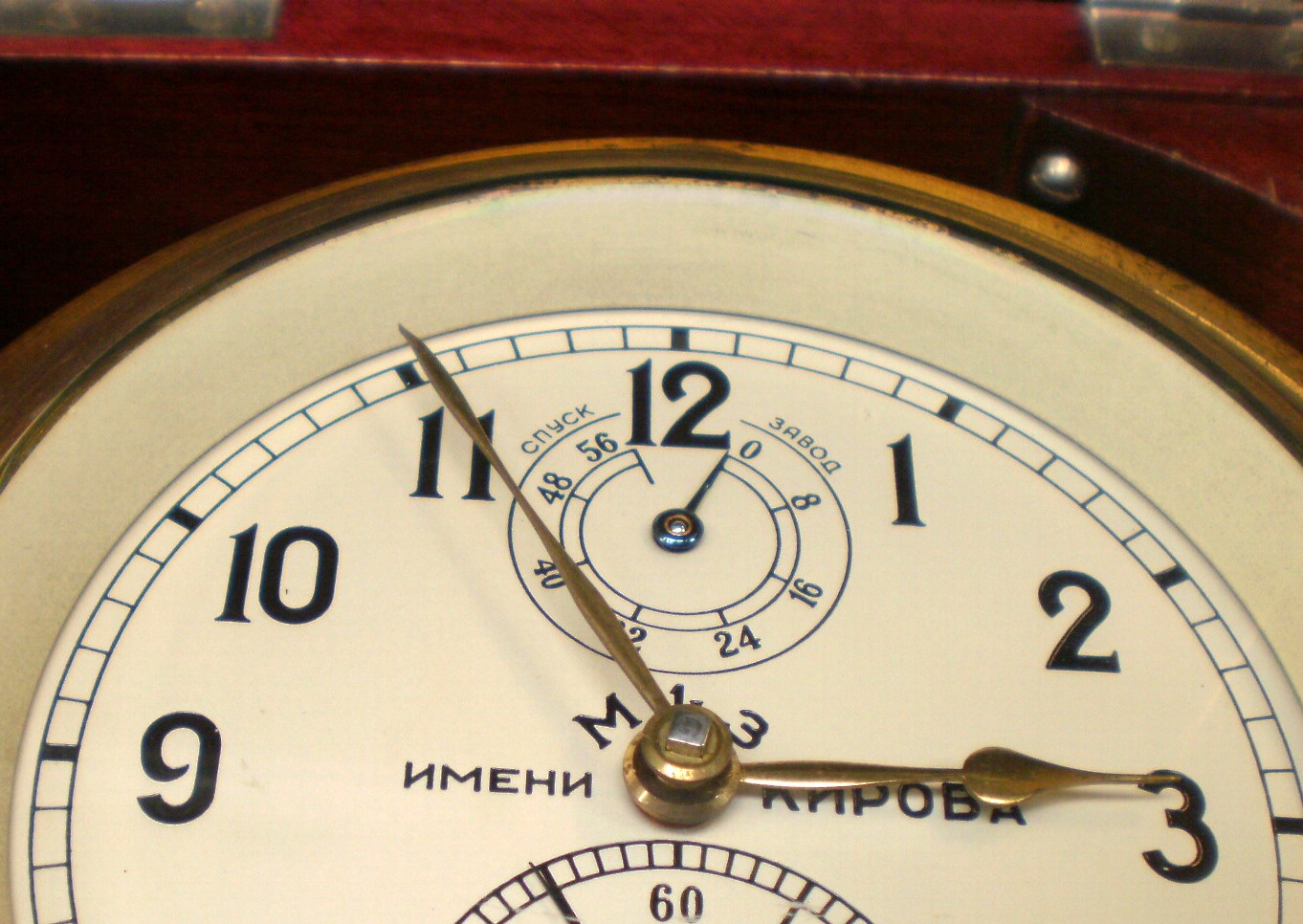
Does the chronometer need to be wound? There is an indicator at the 12 o’clock position that shows how long the chronometer has run since being wound. Usually, fully wound is shown at zero on the right, but it varies a little from maker to maker. Figure 2 shows a fully down Russian MX6 chronometer.

Figure 2 ; Fully run down.

Figure 2 ; Fully run down.

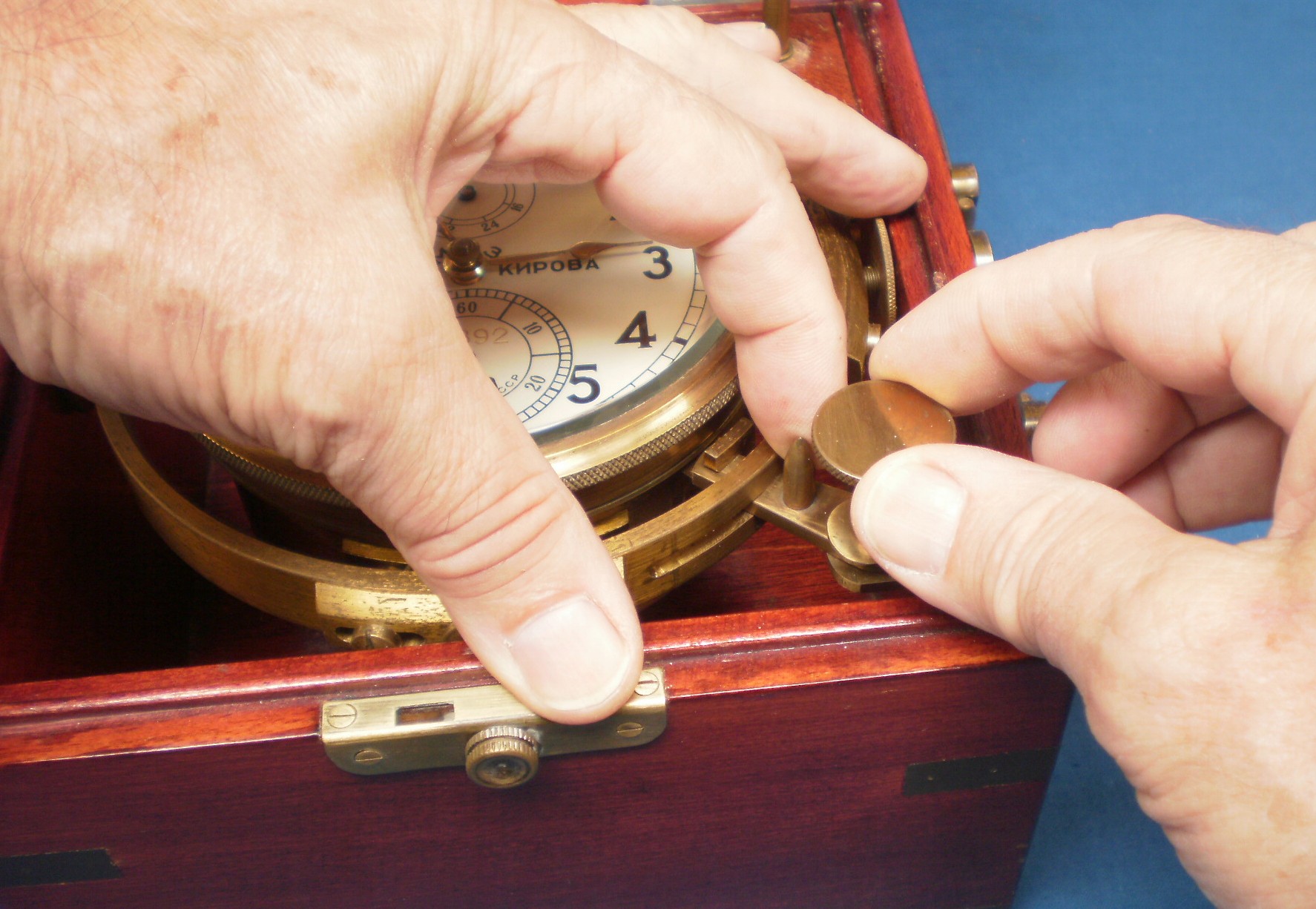
The key hole is on the back, so the gimbal lock has to be released (Figure 3) and the chronometer turned over sideways about the 12 to 6 o’clock axis (Figure 4). The key hole seems to have a blind ending, but if you rotate the cover clockwise, the winding stem will be revealed.

Figure 3 : Unlocking the gimbals.

Figure 3 : Unlocking the gimbals.

Figure 4 : Dust cover and key hole revealed.

Figure 4 : Dust cover and key hole revealed.

You now have to insert the tipsy key and wind it anti-clockwise slowly and steadily (Figure 5). To fully wind a 2- day chronometer, that is to say the vast majority, takes seventeen and a half  half-turns. Twenty four hours run takes seven and a half half-turns and it is worth counting so that you don’t run hard up against the stop-work that prevents overwinding.

Figure 5 : Winding the chronometer

Figure 5 : Winding the chronometer

The winding indicator should then indicate zero (Figure 6). Remove the key and let the dust cover rotate backwards under the control of a finger, as chronometers don’t like sudden mechanical shocks any more than they like rotations.

Figure 6 : Chronometer fully wound.

Figure 6 : Chronometer fully wound.

You can at this point return the instrument to a face up position, but do it handsomely, which is old sailor-speak for “carefully, gently.” Captain Lecky in his famous book “Wrinkles in Practical Navigation,” described how a sailor of his acquaintance returned the chronometer face up by rotating in end for end instead of side to side (Figure 7) and then had no idea how to get it facing the right way again.  I leave this as an exercise for the reader…

Figure 6 : Duh!

Figure 7: Duh!

Once you have the instrument facing the right way, lock the gimbals and leave them locked at all times except when it is on board a vessel. To start the chronometer, rotate it sharply one way through about 30 degrees while face up. This should start it if it is in good order and the balance not corked.

A corked balance is unrelated to corked wine though the source of the cork may be a wine bottle. “In the beginning” describes how to open up the case and Figure 8 shows a cork wedge being inserted (or removed) from a balance.

Figure 7 ; Corking (or uncorking) a balance.

Figure 8 ; Corking (or uncorking) a balance.

The unpractised or heavy handed are better steadying the balance with a fine artist’s camel hair brush rather than with a gloved hand as shown, but if you have a light and delicate touch and are confident that you will not shear off the balance pivots or disturb the timing weights, by all means use a gloved finger, bearing in mind that confidence is the feeling you get when you have failed fully to understand a complex matter. Note that the wedges go directly under the balance arms and are inserted just far enough to arrest movement without dropping out. When removing them, pull them straight out in line with the balance arms.

If you have wound the clock and uncorked the balance, you can use the artist’s brush to rotate the balance to see if it will start. You can also use it gently to stop the balance when necessary.


1. In the beginning…

31 03 2013

Just to be clear, this blog is mainly about the marine chronometer, sometimes called a box chronometer. Some of them were made for use in the air and for use by surveyors, but usually do not differ fundamentally from the basic marine chronometer. I will not be writing about what is nowadays often called a chronometer: a mechanical wrist watch made to standards that meet the requirements of certain Swiss manufacturers’ bodies, nor will I be including what is properly called a  chronograph : a  watch with a stop watch function. However, I will cover a certain class of large watches designed for navigation, as I come across them.

There is very little difference between various makers and you can recognise a marine chronometer because it is in the form of a mechanical (as opposed to quartz) clock that sits in a heavy case face up in gimbals in a fine wooden case with a glass top. A clock is essentially a clockwork motor that is permitted to run down step by equal step by some sort of vibrating mechanism, a pendulum or balance wheel, that in return receives a little energy from the motor to keep it vibrating. The intermediate part that takes care of this exchange is called the escapement and it is this (and the quality of manufacture) that mainly distinguishes the chronometer from a common clock, as it has ben devised to interfere as little as possible with the balance wheel (makers soon learned that a pendulum clock was useless at sea).

Supposing you find a chronometer or are offered one for sale. How do you tell whether it is worth buying? A useful question to ask is “Does it go?” If answered in the negative, it may be because a former owner has carefully prepared it for storage by wedging the balance wheel so that it cannot vibrate and be damaged by careless handling. Hamilton Model 21 chronometers mostly have a special mechanism to do this. It may be that someone has attempted to wind it clockwise with the key provided and found that it just turns round and round without anything happening inside or it may be that it has been wound anticlockwise (correctly) and that nothing has happened on completing the wind. This is because chronometers, unlike lever clocks and watches, are not self starting.

If it does not go, ask the owner if you may wind it and try to start it by giving a brisk turn through about thirty degrees with the face up. If this starts it and the second hand moves half a second at a time with two ticks, a loud one and a much softer one per half second, you have a running chronometer. If it jumps through full seconds, or ticks irregularly you still have  a running instrument but one that needs attention and that should be stopped as soon as you can.

If you cannot start it, (assuming that it is not a Hamilton Mod.21, which will need another post) ask if you may look inside. To do this, you will have to remove it from its gimbals. Tilt the gimbal ring forward so that the 12 is uppermost and rotate the case through 90 degrees. This will allow you to loosen a circular locknut and remove a large screw that acts as a pivot at the top of the ring (Figure 1) and you can then lift the chronometer off the other pivot and manoeuvre it out of the box. You can enlarge the photos by clicking on them, returning to normal by using the back arrow at top left.

Figure 1 : Removing the chronometer from the gimbals

Figure 1 : Removing the chronometer from the gimbals

It is best at this point for you to be wearing close-fitting light rubber gloves to avoid marring the internal finish of the instrument by sweat or dirt. Unscrew the heavy glass top and place it aside and then invert the movement into the fingers of one hand placed around the perihpery of the dial, well away from the hands. With any luck it will fall out of the case on to your fingers (Figure 2) and you can then place it back into its case face downwards. There is a little peg at 12 o-clock that fits into a slot in the edge of the case.

Figure 2 : Removing movement from case.

Figure 2 : Removing movement from case.

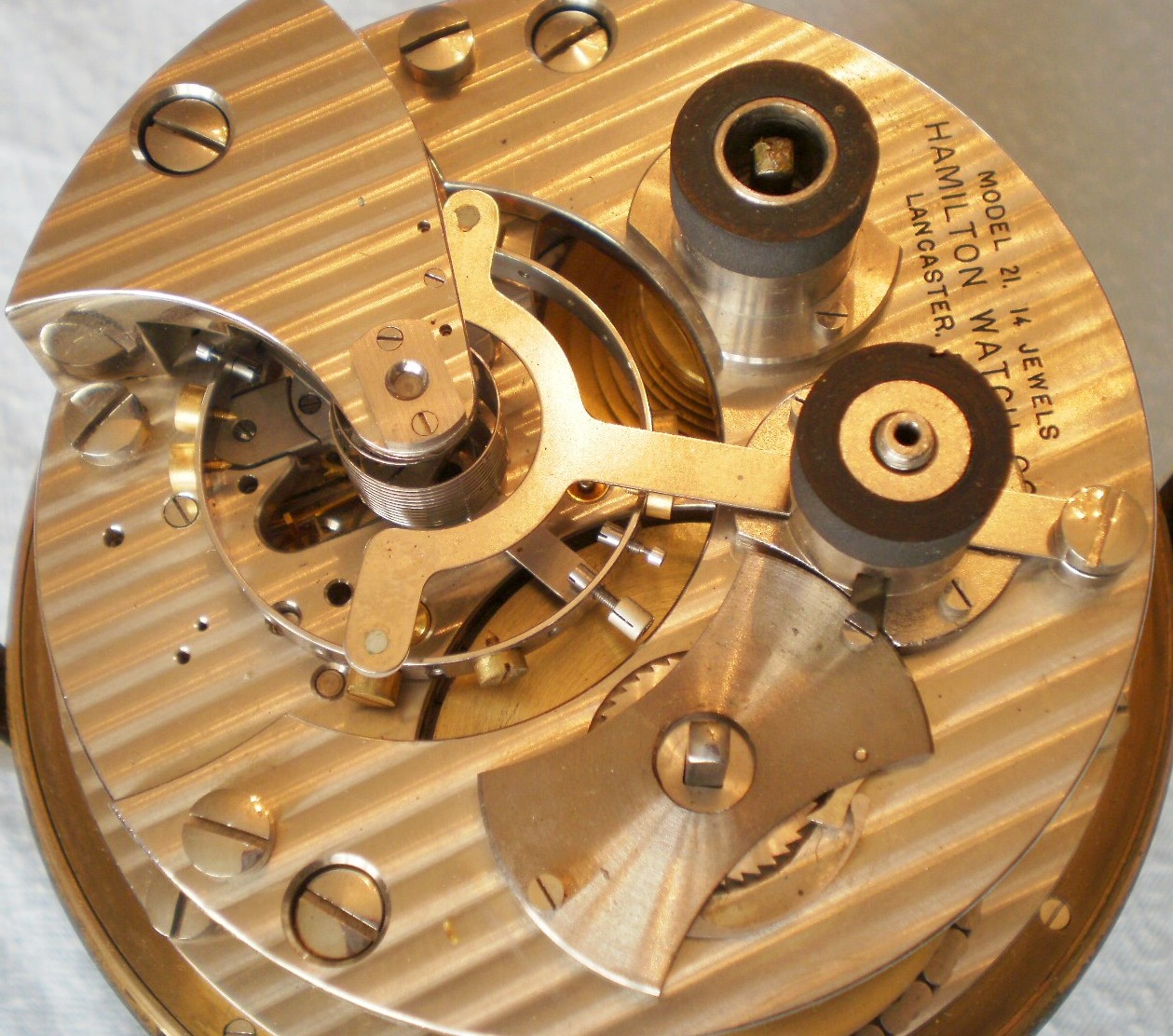
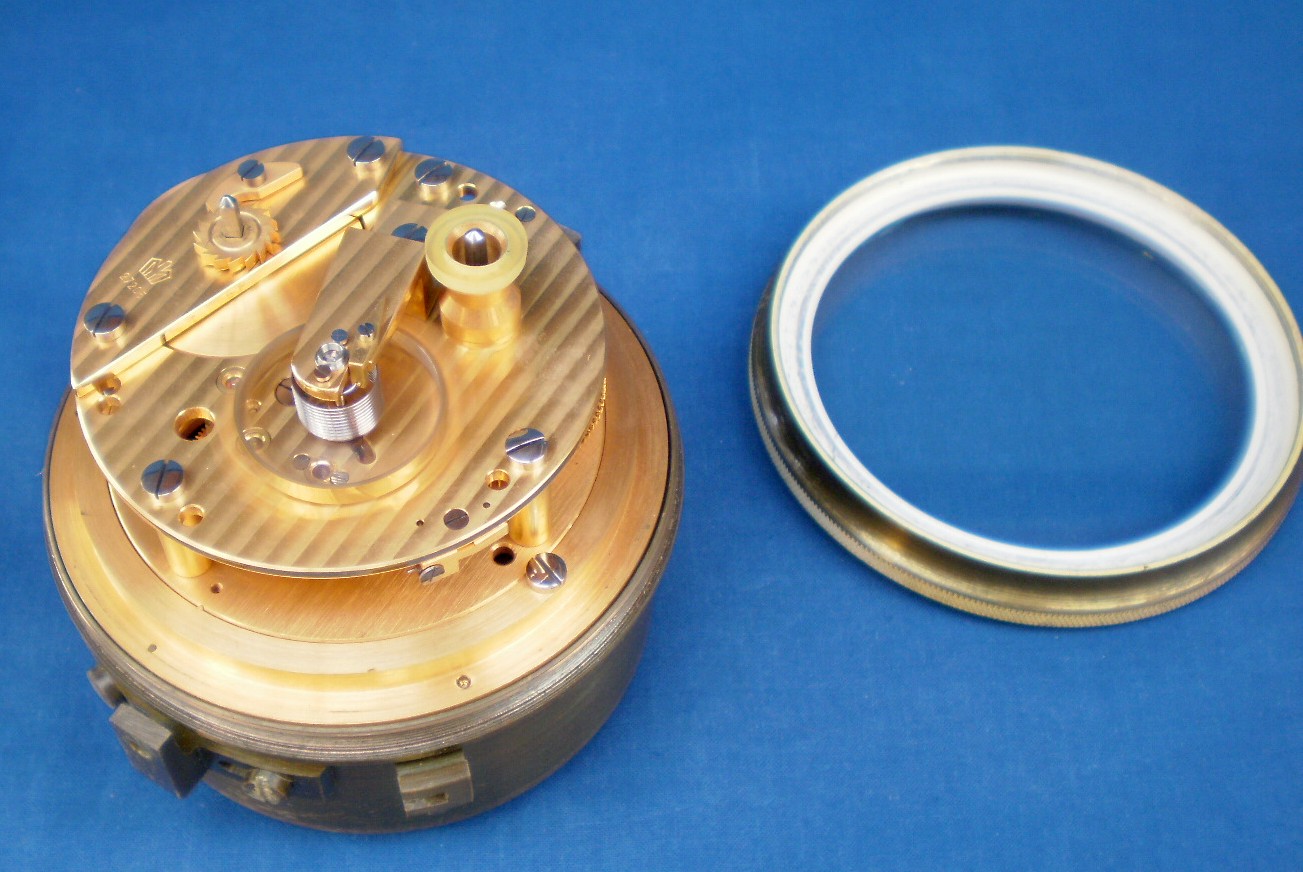
Most chronometers will look something like in Figure 3, unless it is an Ulysse-Nardin or Hamilton Mod 21, when it may look something like in Figure 4. In the latter’s case, you can see the Y-shaped locking fork.  The balance is the ring shaped thing with a helical spring in its centre.

Figure 3 : Movement out if the case.

Figure 3 : Movement out if the case.

Figure 4: Hamilton Model 21.

Figure 4: Hamilton Model 21.

If there are slips of cork underneath the balance, ask the owner if s/he would remove them (carefully, using tweezers) and then try again to see if the instrument will start. If it will not and it is fully wound, you are faced with a bill to overhaul it of US$250 at the least and probably quite a lot more if there is a broken part to be renewed or repaired. This may be well worth while and add value to a chronometer dating from before 1940 and you may well feel that you would like to own a nineteenth  century chronometer, whatever its condition. If it is a mess of rust and verdigris it is probably best left with its present owner unless offered at a price that cannot be refused.

“The Mariner’s Chronometer” will take you safely through the overhaul of most chronometers, which show remarkably little variation between makers from about 1840 onwards, but of course, you embark on this  at your own risk. I well remember that it took me a few days to pluck up the courage to  start an overhaul that at the end of the day may have converted a going instrument, worth perhaps US$2000 on a good day, into an expensive ornament. However, there are really only three delicate components that require more than ordinary care: the balance staff, the detent and the escape wheel. Buy the book and learn more about them. If you have pots of money and bags of time, entrust it to someone with experience of chronometers (a diminishing bunch) and ask if you may watch him or her at work.